Luxury car retailer H.R. Owen open ground-breaking multi-franchise dealership in Hatfield
- Project name
- H.R. Owen Hatfield
- Project sector
- Retail
- Completion date
- 19/03/21
- Client
- Louis de Soissons
Hatfield, once home to the de Havilland Aerodrome, is synonymous with aeronautic speed and power and now hosts a multi-million pound supercar destination.
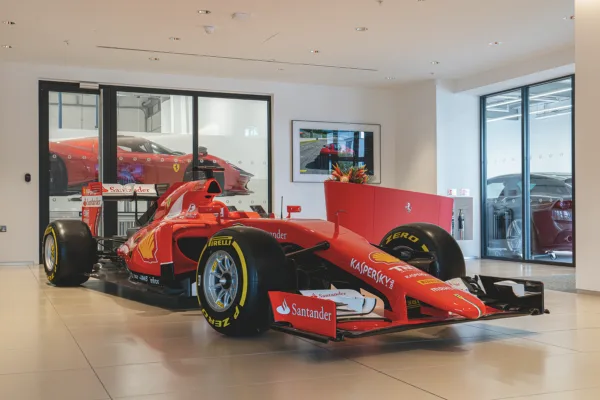
We were thrilled to receive the invitation to contribute to the H.R. Owen Hatfield project, a venture announced by H.R. Owen CEO Ken Choo in 2021. This automotive haven, situated to the north of London, serves as a multi-franchise dealership representing esteemed brands such as Bentley, Ferrari, Lamborghini, Maserati, and includes a specialised Bugatti service centre.
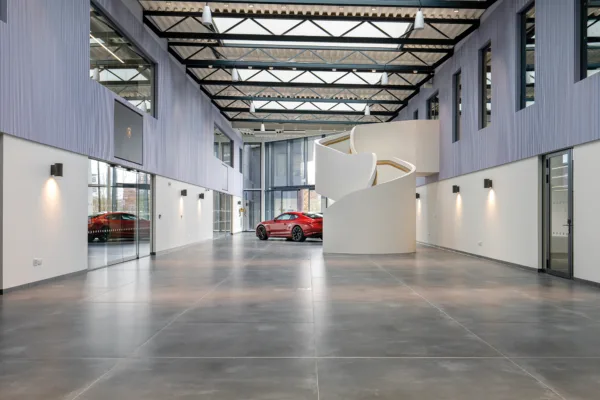
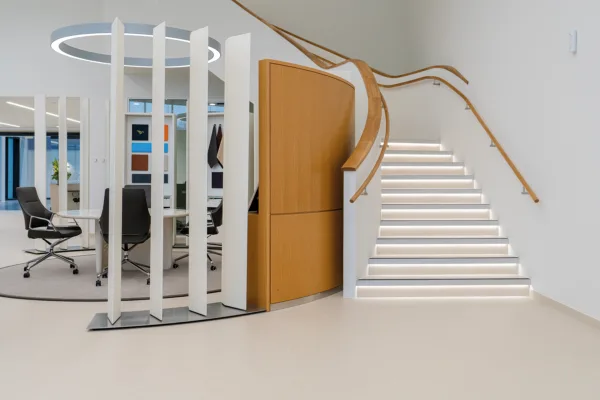
The complex, designed by architects Louis de Soissons, features a distinctive winged roof design that recalls the site’s rich aeronautical history. It comprises an eastern wing housing four showrooms and two workshops, with office spaces arranged around a shared courtyard. The west houses two further showrooms spanning three levels, accompanied by additional workshop facilities and vehicle storage.
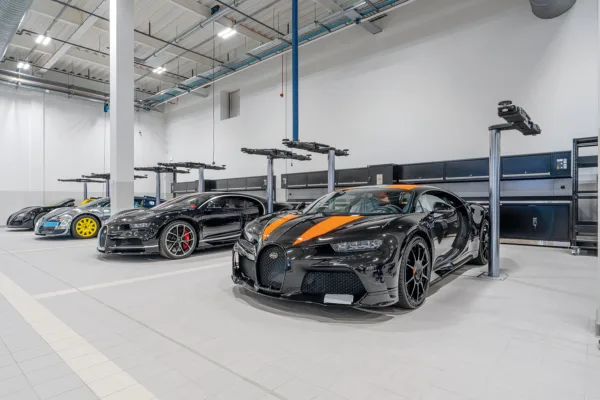
There are technical challenges to overcome when tiling an automotive showroom: surfaces need to be spotless to better display the machines and therefore easily cleaned; they need to be strong and durable to accommodate the moving of the vehicles; more often than not, showrooms have a large footprint requiring a significant amount of flooring.
Lee Simmonds, Solus Area Sales Manager, talked us through the project, “The footprint of the site is large, and to get these 1000x3000x6mm slabs down and brick-bonded, to such a high standard was no mean feat. The reduction in grouting lines means a more expansive feeling to the space that fulfils, and I think exceeds, the original brief of polished concrete.
“Slabs are a relatively new product, and some architects are still a bit uncertain about them, so this was a great opportunity to demonstrate how reliable, safe, practical, and aesthetically pleasing they are. Porcelain has higher technical performance than both polished concrete and natural stone in this context. It has a lower carbon footprint than concrete and can be replaced more easily as it is modular. Natural stone must be sealed and does not have the same uniformity of grip, or durability that porcelain has. A porcelain tile is as good as its substrate, so we made sure to communicate that to the architects.
“The fact that we work with manufacturers that are producing 6mm slabs that you can roll cars over is exciting and I’m delighted to support architects when they specify this type of product. “I think it’s important to point out that we can give advice and support to fulfil the aesthetics of a design brief that is associated with strictly controlled global brand guidelines, as well as on the critical technical qualities of a product, including its sustainability profile.” Lee Simmonds, Area Sales Manager.
The workshops incorporate a highly technical product with excellent grip and load resistance.

CREDIT
- Architecture and Design
Louis de Soissons
- Photography
Richard Washbrooke


