Accreditations and certifications
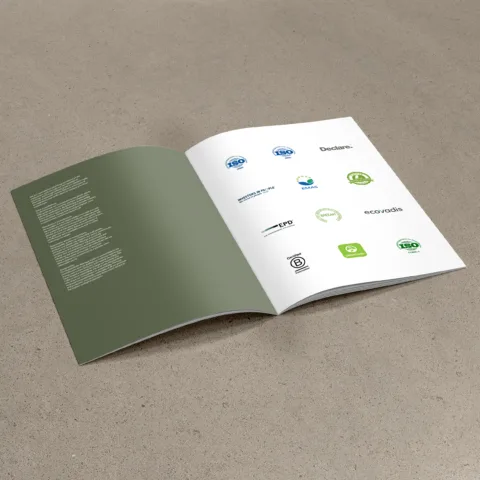
We are committed to minimising our impact on the environment, both through our own operational practices, and through helping guide our clients to make the most sustainable choices. Below is a summary of accreditations and certifications to reassure you of our commitment.
Solus certifications
To demonstrate our commitment to the planet, and to help guide us on our journey, we have obtained the following certifications. By prioritising sustainability, Solus aims to inspire and influence the broader industry, driving positive change and creating a brighter, more environmentally conscious future for all.
ISO 14001 is an international standard that sets out criteria for implementing an effective environmental management system.
It is intended for use by an organisation seeking to manage its environmental responsibilities in a systematic manner that contributes to the environmental pillar of sustainability. It helps an organisation achieve the intended outcomes of its environmental management system, which provide value for the environment, the organisation itself and interested parties.
ISO 9001 is the world’s most recognised quality management system standard, established by the International Organisation for Standardization (ISO).
ISO 9001 helps organisations implement clear, repeatable processes to maintain a quality service for their customers every time.
BES 6001 is a globally recognised certification that assesses how construction products are sourced and manufactured. BES 6001 evaluates every stage of the supply chain, from raw material extraction to final delivery, ensuring transparency, traceability, and strong sustainability practices.
Our BES 6001 certification applies to all our Solus Plus ranges. By choosing Solus Plus products, you’re selecting collections from factories that meet these rigorous standards and demonstrate industry-leading responsibility.
When specified through Solus, these products can also contribute valuable credits toward BREEAM, LEED and WELL certification, supporting your environmental goals without compromising quality or design. Look for the Solus Plus symbol to specify with confidence.
People are central to our sustainability strategy. We're delighted to be certified Investors in People Gold. It's a remarkable achievement attained by only 28% of assessed businesses, and a reflection of the incredible work that our people team do here at Solus in cultivating a positive and empowering work environment.
Manufacturer accreditations
As suppliers, it is our responsibility to provide you with the necessary information to help you make educated and guided decisions on the products you specify. We assess all of the manufacturers we work with to ensure they align with our values. Below is a summary of certifications and accreditations to look for when searching our ranges.
The EU Eco-Management and Audit Scheme (EMAS) is a premium management instrument developed by the European Commission for companies and other organisations to evaluate, report, and improve their environmental performance.
Organisations implement an Environmental Management System (EMS), set up procedures to assess and improve their environmental performance. The requirements include:
- Legal compliance with all environmental legislation, checked by a verifier and a public authority
- Continuous improvement of environmental performance
- Verification of the performance by a specifically trained verifier
- Publication of key environmental data in an annual report, the environment statement
- The scheme has been operative since April 1995 and has been amended several times
EcoVadis provides holistic sustainability ratings service of companies. The EcoVadis Rating covers a broad range of non-financial management systems including Environmental, Labour & Human Rights, Ethics and Sustainable Procurement impacts.
These evidence-based assessments are refined into scorecards, providing zero to one hundred scores, and medals (bronze, silver, gold), when applicable. Additionally, the scorecards provide guidance on strengths and improvement areas, which companies may use to focus their sustainability efforts and develop corrective action plans to improve their sustainability performance
B Corp Certification demonstrates that a business meets high standards of verified performance, accountability, and transparency on factors from employee benefits and charitable giving to supply chain practices and input materials. In order to achieve certification, a company must:
- Demonstrate high social and environmental performance by achieving a B Impact Assessment score of 80 or above and passing our risk review. Multinational corporations must also meet baseline requirement standards.
- Make a legal commitment by changing their corporate governance structure to be accountable to all stakeholders, not just shareholders, and achieve benefit corporation status if available in their jurisdiction.
- Exhibit transparency by allowing information about their performance measured against B Lab’s standards to be publicly available on their B Corp profile on B Lab’s website.
ISO 14001 is an international standard that sets out criteria for implementing an effective environmental management system.
It is intended for use by an organisation seeking to manage its environmental responsibilities in a systematic manner that contributes to the environmental pillar of sustainability. It helps an organisation achieve the intended outcomes of its environmental management system, which provide value for the environment, the organisation itself and interested parties.
This is an industry-specific standard that outlines requirements for sustainable tiles and installation materials. It assesses products throughout their life cycle using qualitative and quantitative indicators for environmental performance, social and economic responsibility pertaining to the design, manufacture, installation, and use of ceramic tiling systems.
It aims to:
- promote the development and use of sustainable ceramic tiles and installation materials;
- guide all stakeholders in environmental responsibility throughout the supply chain for tiles and installation materials;
- provide a verifiable resource for tile product specification and for design professionals, contractors and consumers to identify sustainable tiles and installation materials;
- increase the value of sustainable tiles and installation materials throughout the supply chain by creating greater market awareness and demand.
Product-specific accreditations
Some accreditations are specific to a particular range, rather than the manufacturer as a whole. This means that the whole range has been assessed against the criteria before being given the certification. We have summarised these accreditations below.
An EPD (Environmental Product Declaration) is an internationally standardised document (ISO) that transparently communicates the environmental performance or impact of any product or material based on Life Cycle Assessment (LCA) methodology. The LCA is guided by Product Category Rules (PCR) making it possible to compare the impacts of different materials and products to select the most sustainable option to reduce carbon emissions.
They help architects, engineers and designers choose the most sustainable option for their project. An EPD must be verified by a third party and is usually valid for five years and is generated according to the relevant standards.
EPDs help to achieve EPD and LCA credits in certification schemes, like LEED, BREEAM and others.
UL GREENGUARD Certification for low chemical emission products helps demonstrate both compliance with key chemical emission standards and a commitment to healthier indoor environments.
Airborne chemicals are commonly referred to as volatile organic compounds (VOCs), used to manufacture and maintain building materials, interior furnishing, cleaning products and personal care products.
There may be anywhere from 50 to hundreds of individual VOCs circulating in indoor air at any time. Some may produce objectionable odours at low levels, but many have no noticeable smell.
Many VOCs are irritants and can cause headaches; eye, nose and throat irritation; and dizziness. Long-term exposure to certain VOCs may lead to chronic diseases or cancer.
The products that we use to build and furnish our indoor environments can have a significant impact on indoor air pollution levels.
UL GREENGUARD Certification program has established test methods and emission limits for a variety of product groups.
The goal of Declare is to position the building product sector within a transparent materials economy.
Declare is an ingredients label for building products, paired with an online database. It allows manufacturers to demonstrate their leadership in the marketplace and it provides consumers with honest information for product selection.
All products are eligible for inclusion, regardless of their composition; the key to Declare is honest information sharing. Information about each product has been decalred by the Manufacturers’ CEO to be true. This database is provided by the internItional Living Future Institute (ILFI) as a tool for registered project teams.