Raising the bar: What it really takes to achieve BREEAM Excellence
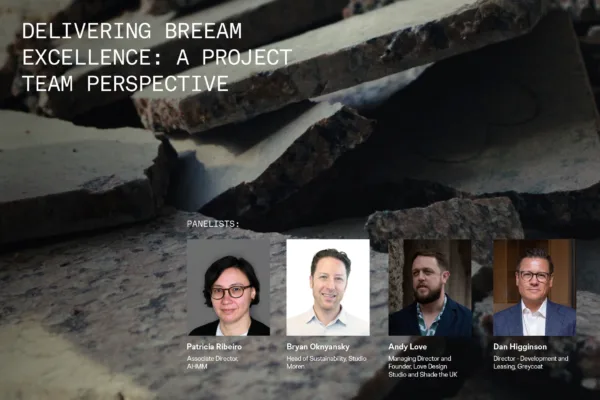
In March 2026, Solus hosted a panel discussion on one of the built environment’s most debated frameworks: BREEAM. The event brought together four leading voices to explore the practical realities of certification, from early design ambition through to investment value and supply‑chain challenges.
Chaired by Luke Bajic, Specialist Product Consultant at Solus, with moderation shared by Ken Graham, Sustainability Manager at Solus, the panel featured Patricia Ribeiro, Associate Director at AHMM and project lead for Botanic Place, Cambridge; Bryan Oknyansky, Head of Sustainability at Studio Moren; Andy Love, founder of Love Design Studio and a BREEAM assessor; and Dan Higginson, Director of Development and Leasing at Greycoat.
Drawing on live projects including Botanic Place, which achieved a 100% BREEAM score at design stage, and the recently completed Finsbury Dials retrofit in London, the conversation was frank, technically grounded and refreshingly honest. Four themes emerged.
You can listen to the conversation below.
Start before you think you need to
The most consistent message of the evening was also the simplest: sustainability ambition must be present before design begins. On the projects where BREEAM Outstanding was achieved, it was because the target was baked into the client brief from the outset, not added at planning stage or delegated to the assessor mid-stream. Credits available at Stage 2 are the easiest to win and, when a team is appointed late, the easiest to lose permanently. The panel was clear: BREEAM is not the assessor's problem. It belongs to the whole team, from directors to contractors on site, and the most effective projects treat it that way from day one.
Business as usual, done better
Achieving BREEAM Excellent does not necessarily require going beyond normal good practice in building design; it requires approaching that practice more deliberately. The framework's real value lies in raising the parts of a conventional design process where environmental considerations get set aside, such as waste management, material sourcing, end-of-life thinking, and making them legible and evidenced. The panel noted that pursuing multiple certifications in parallel (WELL, NABERS, BREEAM and others) tends to produce stronger outcomes than any single framework pursued in isolation, because the discipline of each reinforces the others. Constraints, the panel agreed, do not diminish design but sharpen it.
The investment case is real, but nuanced
Developers pursue high BREEAM ratings for a combination of planning requirements and market logic. The panel was sceptical of the idea that Outstanding commands a straightforward rental premium; the evidence is more diffuse. What the certification reliably delivers is legibility: a recognised signal that an asset meets a credible sustainability threshold, which matters increasingly to lenders and capital partners assessing long-term liquidity. The panel's conclusion was that BREEAM functions less as a value-add badge and more as a baseline expectation for best-in-class product: one that the investment market increasingly takes for granted.
Circularity takes longer than you think
Reuse and circularity were recurring themes, and the panel's collective experience was consistent: strategies that look straightforward on paper bring surprises in practice. Procurement of reclaimed materials takes time; supply chains are unpredictable; some packages are simply too small to attract fabricators. BREEAM v7, the panel noted approvingly, is moving in the right direction by tightening life cycle carbon assessment requirements, rewarding adaptability and future-proofing, and encouraging buildings designed for long operational lives. But the framework's growing reliance on EPDs risks narrowing the supply chain, making it harder for smaller or more innovative producers to compete with large established manufacturers who can absorb the cost of certification.
The shared barrier named by every panellist at the close of the evening was time: not just programme pressure, but the time needed to test, iterate, collaborate and absorb the unexpected. The projects that achieve the highest BREEAM ratings, the panel concluded, are the ones where that time is built in from the start, and where sustainability is understood not as a certification target, but as what a responsible project should be doing anyway.
Key takeaways:
- Appoint your BREEAM assessor early. Credits missed at Stage 1 and 2 often cannot be recovered.
- Sustainability ambition belongs in the client brief before pen goes to paper.
- BREEAM Outstanding is an output of integrated good practice, not a target pursued in isolation.
- Train the whole team: contractors, juniors and directors need to speak the same language.
- The investment case rests on market legibility, not a clean rental premium.
- Circularity and reuse require procurement time and early design latitude.
- BREEAM v7 rewards future-proofing and tightens life cycle carbon requirements: a positive direction of travel.
- EPD requirements risk excluding smaller, innovative suppliers who cannot afford certification.
NEWSLETTER
Get the latest news and updates sent straight to your inbox.

ReCover: designing for change, not waste
17th Feb 2026

Solus celebrates 30 years
11th Dec 2025


Goodbye to 2024
17th Dec 2024

Spolia longlisted for Dezeen Awards
12th Sept 2024


How can design drive optimism and change?
15th Jun 2023


In conversation with Mauro Mazzi, CEO of Mirage
17th Apr 2023


Meet Ken Graham, Sustainability Manager
23rd May 2022

