Jo Sinclair, Events Manager, on curating the unexpected at Clerkenwell Design Week
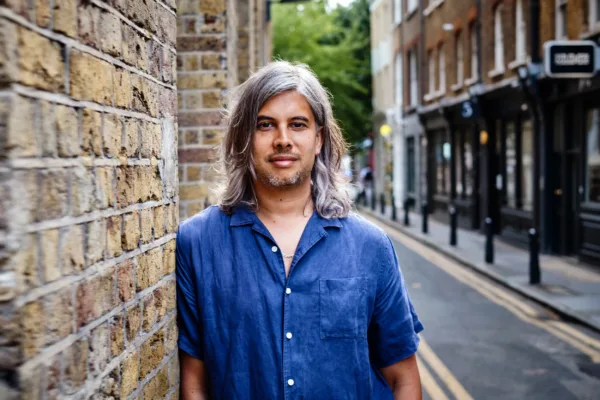
Jo Sinclair is the Events and Library Manager at Solus Clerkenwell. A man of contrasts who unifies the reflective quiet of the downstairs tile library and the sometimes-boisterous upstairs community space. As comfortable with a hush as he is with a rush, Jo puts on events throughout the year, but Clerkenwell Design Week is the big beast. Conleth Buckley caught up with him post-CDW to get his reflections on this year's ambitious programme.
Conleth
Hey Jo, congratulations on another successful CDW programme. It seems as though every year gets bigger and better. Can you give us an insight into the themes and objectives of this year’s programme?
Jo
Thanks Con, appreciate you mate.
Staples is a stripped back, down to the fundamentals concept. An examination and celebration of the things we can’t do without, but don’t always appreciate as much as we could. The installation that SMITHs produced, an oversized L shaped table, is a fantastic response to the brief, it facilitates humanity in the most understated yet luxurious way. My role has been to deliver activations that bring the Staples table to life - exploring staples in as many different forms of interaction and meaning as possible.
Conleth
Last year, we described the programme as “all thriller, no filler”. What was the scale this year in terms of numbers: attendees, events, partners?
Jo
It felt that way last year, and yet this year we did even more across booking, programming and production. We planned and delivered 21 activations over 3 days, up from 17 last year. 3 of our events hit capacity within a day of tickets going live, and 2 had queues go around the block. On the digital front, LinkedIn impressions rose over 200% compared to last year and Instagram engagement jumped 700% week-on-week. Thousands of RSVPs poured in during the build up and over 3000 attended. My legs definitely felt it.
Conleth
Which event do you feel represented best what you and Solus are trying to achieve?
Jo
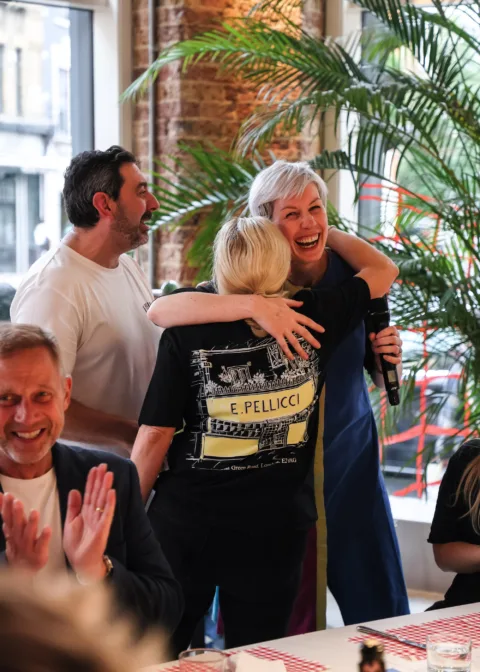
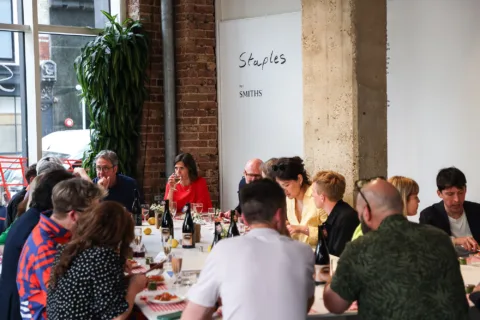
I’d say the E. Pellicci private dinner. Closing our doors to all but a select 25 clients was a bold move from everyone involved. This was a full-blown event - multiple contributors, musicians, DJs, and event staff - as we transformed the showroom into a restaurant in tribute to the cult café from Bethnal Green. The trust Sam places in us to make these deep-cut cultural programming choices honestly blows me away. I knew who E. Pellicci were, and that was enough. From there, our brilliant team did what they always do: coming together to create something that felt genuinely special. On the night, a serendipitous moment between Dezeen’s Events Director Claire Barrett and Anna and Nev from E. Pellicci quietly affirmed the power of doing something good for its own sake and not just because it sells.
Conleth
How was the response this year? Any surprises or memorable moments?
Jo
The response from our client-base has been overwhelming, they appear to be really tuned in to what we’re doing here. The RVSPs can be hard to manage though, a good problem to have!
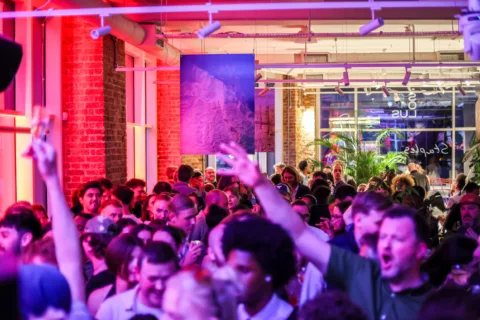
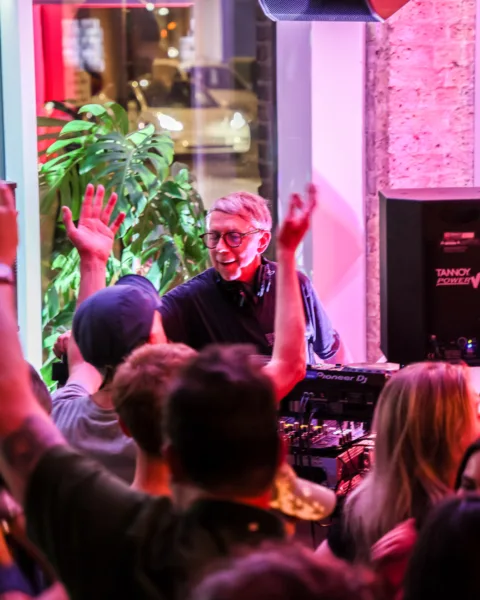
The most pleasant surprise for me was seeing how much Gilles Peterson enjoyed himself. This was satisfying because, after all, most of the year this is a tile shop. It takes a lot of work from a lot of people to make the transformation. If Gilles is happy with it, it’s got to be pretty good. He also played an extra half an hour which was thrilling, the perfect send off to an emotional journey.
Conleth
A programme like this must come with logistical challenges. What did you learn operationally this year, from planning to execution?
Jo
From an operational standpoint I’m still learning how best to manage the transition from a relatively tranquil sales environment to something closer to a mini–Barbican Centre.
I’ve learned that in the initial stages, to be patient with organisers and contributors in terms of headspace. 2-3 months out, only a select few are thinking about the details that intensively, most have many other more pressing responsibilities, politely pester and ignore the instinct that makes you feel like you’re bothering people. Communication throughout is obviously something you can’t really have enough of, particularly when you’re shifting the purpose of the space in such a deliberate way. So, notes for Jo – talk normal, don’t try and be funny or stylise things, just be clear, polite and kind.
On the day the lesson I learned is - resist the urge to second-guess. I had a few moments where I doubled back, only to end up following the original plan anyway. Event days featuring 6 - 7 separate activations can be a blur, it’s hard to stay detail oriented, which is why you put maximum thought into the planning stage, listen very closely to everyone involved, brief clearly, and assign distinct roles. It’s not panic exactly, more a kind of over-analysis that can creep in. Trusting the groundwork is key.
Conleth
Looking back on your terrarium workshops in 2023 and the significant upswing in 2024, how do you feel about the evolution of Solus’ CDW offer?
Jo
When I first joined, I assumed Solus would simply grow around us. What I didn’t expect was how much we would change with it.
In the post-Covid landscape, creative workshops felt like the new rock and roll - mass therapy for the people. Then came Sam, James and Simon’s Sounds of the Earth, which nudged us toward larger scale conceptual event thinking. For me, booking Daniel Avery for CDW ’24 was a real turning point. It made me realise that huge, creative breakthroughs are possible. I still can’t quite grasp how mad that was. The past two years of CDW have involved a hefty dose of consolidating our strengths alongside chasing new exciting concepts. This year was another step forward in both directions.
I still don’t think we’ve seen the limit of what Solus can do, because we’re on the same path as individuals.
Conleth
Looking forward, can you give us any hints on your plans for next year?
Jo
Sam and Ian are always working on massive things in the background and Solus is always either observing or actively engaged in the most interesting projects and ideas coming out of the design world, so I would expect that to be reflected next year. For the spice, the parts that I most enjoy, with activations like E. Pellicci, Dusty Knuckle, Le Labo and Gilles Peterson I think we found our level this year, I think going forward I would be looking at more things of that stature.
Conleth
Finally, what advice would you give to other creatives or brands looking to stage experiential programmes during major events?
Jo
Hospitality is an area that’s continually underestimated. It’s real and there are levels to it. If no one on your team has proper hospitality pedigree, find someone who does. And by high-level, I don’t mean cocktails with rosemary smoke - I mean social radar, backstage rigour, cultural sensitivity, and actual human warmth. A bartender’s interpersonal skills alone can shape the tone of someone’s whole evening.
Events are ultimately about curating message. Direct formats, like panel talks or CPDs - are essential and should sit at the core. But the implicit elements are just as powerful: sensory activities like music, food, hands on demonstrations, the atmosphere, the feeling. In creative industries, emotional resonance often lands harder than logic. As Maya Angelou said, “People will forget what you said, people will forget what you did, but people will never forget how you made them feel.”
Above all, value your guests' pleasure. That takes sacrifice, self-awareness, and taste. It’s not enough to import culture - you have to live it, know where it came from, and have a feel for what people really want.
NEWSLETTER
Get the latest news and updates sent straight to your inbox.

That's a wrap on Clerkenwell Design Week 2025
27th May 2025


Meet the team: Domhnall McLaughlin
10th Jun 2026


Meet the team: Jade Whiteside
24th Apr 2026

Hearing the Eyes of the Skin
23rd Mar 2026

Under the Table with Glenn Howells
16th Jan 2026

Solus celebrates 30 years
11th Dec 2025

Under the Table with Ian Simpson of SimpsonHaugh
22nd Oct 2025


Meet the team: Luke Bajic, Specialist Product Consultant
29th Sept 2025


Under the Table with Simon Allford
29th May 2025


Meet the team: Aaron Taylor, London Area Sales Manager
30th Jan 2025

Meet the team: Lauren Riley, London Area Sales Manager
29th Jan 2025

Goodbye to 2024
17th Dec 2024


The story of the Ceramophone
23rd Feb 2024

Building Minds: In conversation with Frank Bruno
17th Jan 2024


In conversation with Juhani Pallasmaa
2nd Nov 2023


Solus Clerkenwell reopens its doors
31st Jul 2023

In conversation with Roger Tyrrell
21st Jun 2023

How can design drive optimism and change?
15th Jun 2023


In conversation with Mauro Mazzi, CEO of Mirage
17th Apr 2023


How do materials shape positive experiences?
6th Oct 2022

How can the design industry lead with purpose?
13th Jul 2022

Solus sponsors Birmingham charity walkathon
7th Jul 2022

Meet Ken Graham, Sustainability Manager
23rd May 2022

Solus celebrates 25 years
16th Mar 2020