Under the Table with Glenn Howells
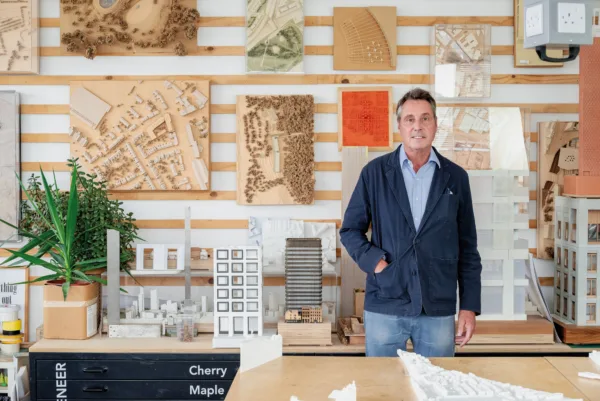
Under the Table is an interview series with leading architects, designers and creatives exploring the ideas, experiences and influence that inform their practice.
In this edition of Under the Table, Glenn Howells of Howells tells us about his early influences, what led him into architecture and how he established one of the most successful practices in the UK. This short film by Superbeam offers an insight into Glenn’s approach and the ethos that defines his work.
The article below is a write up of the full conversation and goes into more depth about Glenn’s thoughts on purpose, meaning and craft.
Glenn Howells is not the sort of architect to dwell on legacy. In conversation, he is forwardfacing: more interested in what’s taking shape than what’s already built. But it’s hard to ignore the scale and substance of the practice that bears his full name: or rather, did. In 2023, Glenn Howells Architects became simply Howells: a quiet but deliberate shift that reflected deeper changes within the practice. Now led by a broader senior team and operating from studios in Birmingham, London and Dublin, the rebrand signalled a redistribution of authorship and an expression of intent.
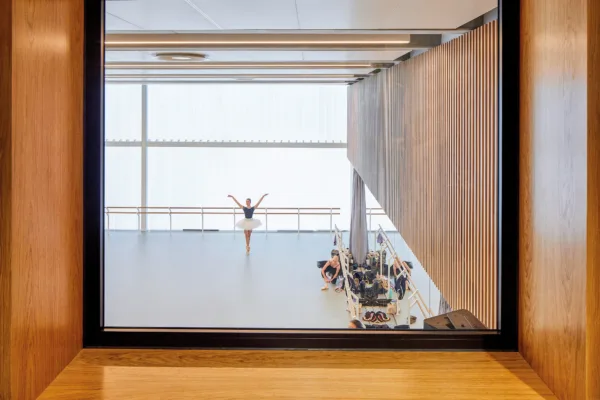
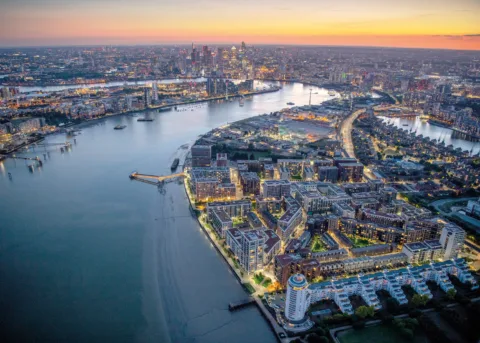
It’s a logical step for a practice whose output has long been defined by outstanding architecture, civic ambition, and collaborative ethos. The Howells’ project list is long and significant. From the Custard Factory which kickstarted the ongoing renaissance of Digbeth, to the Savill Building in Windsor Great Park with its remarkable gridshell roof, to London City Island which holds within it the poised elegance of the English National Ballet’s Mulryan Centre for Dance, to a redefined typology of motorway service stations in Gloucestershire. Howells’ work has for some time framed the warp and weft of life in the UK.
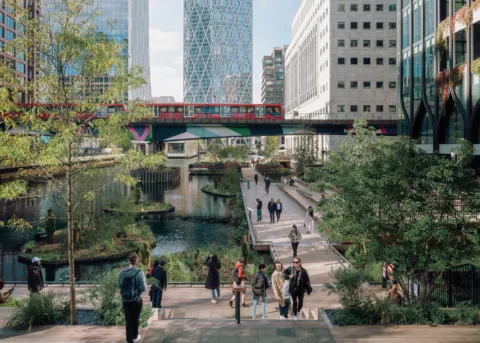
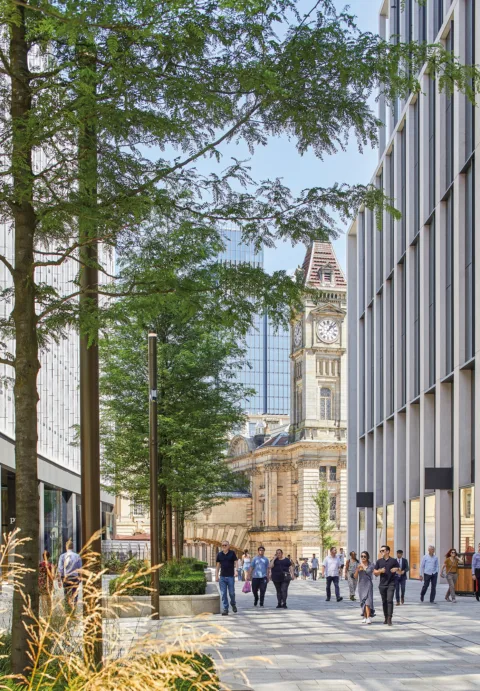
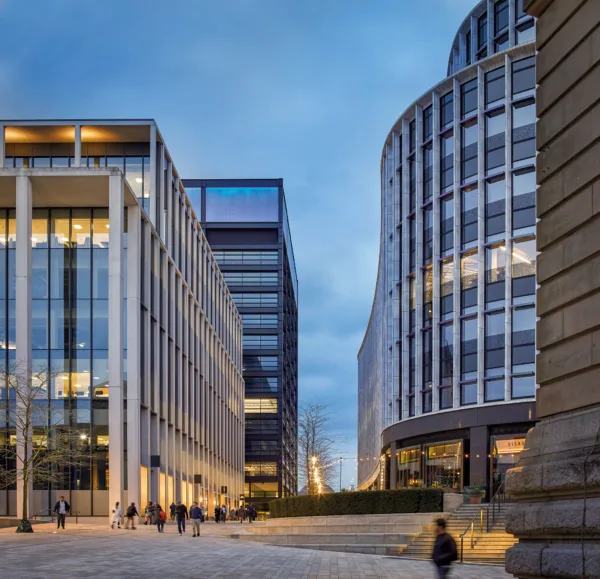
Howells’ contextually attentive and singularly imaginative approach to place-making has helped the practice grow into a soughtafter master planner. In London, they have reimagined Canary Wharf as a water garden and Royal Wharf as a tapestry of spaces that stretches to the Thames Barrier. In Birmingham, with the Paradise plan, they unlocked the 19th century splendours of Chamberlain Square, giving the city back its heart. And the tenacious ambition of the Our Future City plan makes sense of the palimpsest of urban development that characterises Birmingham, envisaging a more liveable city of thriving, connected neighbourhoods.
Our Creative Director, Sam Frith and our Managing Director, Ryan Bennett met Glenn at Howells’ London studio in Fitzrovia.
How did you come to architecture?
Architecture’s an interesting one, isn’t it? I’ve always been keen on the word building rather than architecture, to be honest: and I think that’s because of how I grew up. My dad was a builder; he left school at 14. So, my first experience of buildings was as something you do: a verb, not a noun. I watched him, a trained carpenter, fashion things out of timber with real skill and put together quite amazing structures.
He was a first fix carpenter who specialised in roofs, and he was very good at them. He’d done a seven-year apprenticeship, so he could do everything from setting out to fine joinery. I’ve still got his tools: huge saws, delicate chisels, beautifully kept. I grew up with the sense that a building came from materials, from process. It wasn’t abstract; it was a process of making.
I was the first in my family to go into higher education, so there wasn’t a clear path into architecture. And I didn’t go into it because it was a respected profession. I liked drawing. I liked buildings, and my dad was builder. That was enough for me. When we went on holiday, my dad would always point out how things were made from stone, metal, brick and wood; and he’d tell the story of how the properties of materials led to form and connections.
Your dad must have been delighted with the Savill Building in Windsor Great Park given his line of work?
Oh! He went and saw it. He was blown away. We also took him to the timber walkway at Westonbirt Arboretum. He loved the idea. Before Airfix kits came along, he’d grown up building model planes from balsa wood, so he was always fascinated by the Mosquito aircraft and the way it used timber lattices to form something incredibly strong. These were then covered in tissue paper and sealed with dope, which would shrink tight over the frame. He loved the idea that you could make incredibly strong structures using very little material.
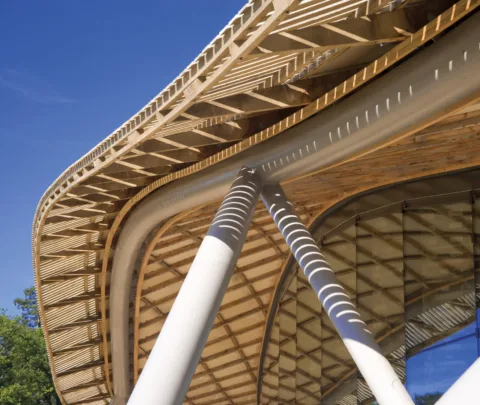
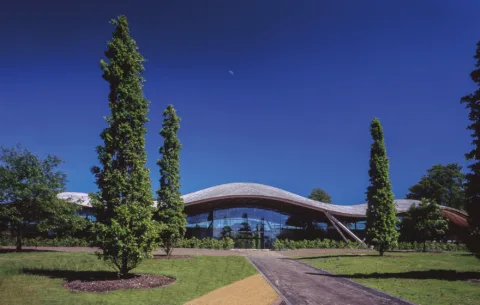
That’s exactly what he found interesting in the Savill Building. It uses a grid shell roof, which is a structural system that relies on curvature for strength. Like the shell of an egg, double curvature makes it inherently strong. It’s the same principle as corrugating metal to increase stiffness. With timber, you’re usually working with large, machined sections that function as beams. But with a grid shell, you use much thinner timbers, bend them into arches, and interlace them to create a dome-like structure. That curvature allows you to span far greater distances than you could with straight beams.
The Savill Building spans over 30 metres, and the roof is just 300 millimetres thick; that’s a span ratio of 1:100, compared to the usual 1:20. It’s elegant, efficient, and comes a kind of craft logic that my dad really appreciated.
How did growing up in the Midlands shape your outlook and career in architecture?
I was born in Stourbridge. Back then, the Midlands was a very different place. It wasn’t a financial district like the Southeast: it was about making things. My grandfather worked in one of the largest steelworks in the world. My mum worked in a local factory that made beautiful cut glass by hand. And, as I’ve said, my dad was a builder. Everyone around me was involved in manufacturing or craft in some form.
Birmingham used to be called the city of a thousand trades: and rightly so. It made everything: tools, engines, bicycles, jewellery, buttons. That culture of making shaped everything. It made you think differently about materials, about work, about the value of things well made. After school, during the Winter of Discontent, I took a job driving between factories across the region. One day I’d be in a shed watching someone machine stainless steel parts; the next, I’d be in a foundry or light fitting assembly line. These weren’t glamorous buildings, but the work was good and skilled. It left a deep impression.
Stourbridge itself was a creative place. As a teenager, all my closest mates were artists. My best friend went to Stourbridge Art School, and I spent a lot of time around that crowd. They were cooler than anyone else I knew. He went on to art school in London, and I followed him down a bit later. I met loads of people through him. Everyone was in a band back then. I was in a decent one at school, but to earn money I played in a country and western band at working men’s clubs around Cradley and Lye. We’d get fifteen quid for a three-hour set, which felt like good money in 1979. We wore Velcrofastened nylon outfits and played until the bingo started, which was the main event.
But I started to see where that road led. I’d go into music shops like Modern Music in Dudley and see older guys, brilliant musicians, still playing Stairway to Heaven on display guitars. They were waiting for something to happen. And I thought: I don’t want to end up like that.
Then one day I opened the New Musical Express and saw an ad on the back page: Why not study architecture in Plymouth? I’d always been interested, but that gave me the push. That’s how it started.
Did Birmingham lose its way a little bit?
It’s been a long journey. I do think Birmingham lost its way, especially in the ’60s and ’70s. There was so much damage done during that period, the Manzoni Plan in particular. All around the markets, you ended up with these bizarre five-metre level changes, roads that didn’t go anywhere. If you look at old maps, you see it was once a marvellous hill town: connected streets, small squares, proper walkable neighbourhoods. And we just tore so much of that apart.
Most of what we’ve been involved in over the last 20 years has been about repairing that damage. Not through individual buildings (buildings will always change) but by reopening connections, stitching the city back together. Reinstating public space as the most important thing in the city. That’s what matters.
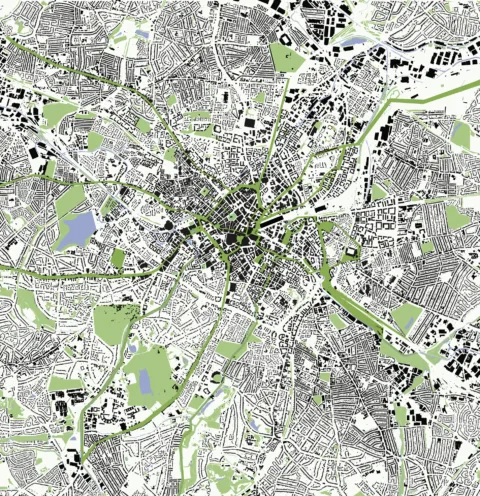
For cities like Birmingham to thrive, they need to be attractive and accessible to young people. And right now, we’re still seeing a migration of talent to London. The infrastructure just isn’t there. You look at a transport map of London, then compare it to Birmingham at the same scale, it’s shocking. There’s ten times more connectivity in London. That stuff matters, especially for younger people who don’t want to or can’t afford to jump in a taxi every time they go somewhere. Our tram system’s okay, but it’s limited. We need more investment in regional cities, proper investment.
What is architecture to you?
I’ll tell you what it’s not. It’s not about heroic ideas being handed down from above. It’s not about shape-making for the sake of it and letting someone else figure out how to build it.
The architects I’ve admired and worked with have all said the same thing. Architecture is a synthesis: it’s ideas, craftsmanship, a sense of place, a sense of purpose. You have to ask: what is this project actually doing for people?
It’s not an art form, not in the traditional sense. It’s not something you create for yourself to admire. It’s always a collective act. Never solo: always a chorus. The best projects come from many minds working together.
And material knowledge matters. Makers matter. Craftspeople matter. I’ve just come out of a meeting on a timber project outside Manchester. The conversation wasn’t just architects and engineers: the carpenters were there too. We were talking about species of wood, their properties, how that might affect the plan of the building. That’s the level of intelligence and authenticity you get when you bring those people in at the beginning. If you just design something to look good on a rendering and hand it over, you lose all of that.
Can you expand on that? The relationship between architect and trade.
I've always said we’re only architects; we’re not the experts. Our job is to work with people who really know their materials: the people who make the tiles, the bricks, the steel, the timber. Especially the tradespeople on site. They bring an understanding you can’t get from behind a desk.
On the Savill Building for the Crown Estate, we involved the Green Oak carpenters from the start. They showed us how they’d make the timber structure; we didn’t design it in isolation. That kind of collaboration is essential. I’ve often asked builders, “What do you think we should do here?” And they’ll say, “Well, if we build it the way it’s drawn, this will happen.” Usually, they’re right. So, we adapt. You need to be open to that.
My dad, who very rarely swore, said once, after he retired, that he only just realised “fucking” and “architect” were two separate words. He spent decades listening to architects telling him how to build things, and often, they were wrong.
Our ideas have to meet reality and the people who work with their hands every day often have the best grip on what’s possible.
Which Architects do you admire?
I remember, when I was at university, I was always slightly suspicious of grand architects. We had some very grand ones come and teach us; some of them were brilliant, but there was a kind of mythology around them that I didn’t fully trust. The surprising thing is some of the ones you’d expect to be quite grand were actually the opposite: humble, helpful, willing to let you in. They let you see how uncertain they were about things. That was interesting to me.
I used to spend a lot of time in the architecture library, and I’d travel to see buildings. I’d go out specifically to visit something famous by a well-known architect, and then, on the way there or just next to it, I’d find something much better. That happened all the time. One of the books I was shown when I was studying was Architecture Without Architects by Bernard Rudofsky. I think it was published in the 1960s. It’s about vernacular buildings: anonymous buildings made before you had what we’d now call ‘qualified’ architects. They were built by masons, carpenters; people who knew how to make. And some of them are absolutely astonishing.
I’ve got a huge amount of time for that kind of architecture. There’s an authenticity and honesty to those buildings. They weren’t trying to hide materials, they were lean, efficient, what you saw was what they were made of. When I travel, I always try to learn from that kind of work. Rather than read a book, I prefer to look at and try to understand the building, understand where, how, why they were made and what they were made of, what the materials are telling you. It’s a great hobby, actually.
I’ve always leaned more towards designers than architects. Buckminster Fuller’s a good example. He came into design after the death of his daughter. He had a moment where his life was falling apart. He just lay on his back and looked at the stars and realised there was something that he could live for, he could rebuild his life around creation. He was a polymath, a systems thinker, he connected things. That’s something I’ve always responded to.
Charles and Ray Eames along with Jean Prouvé, he had a factory of his own. People who made things, who were immersed in process. Cedric Price, Louis Kahn through to Renzo Piano: these are people who’ve understood architecture as a consequence of process, not just as a shapemaking exercise. And if you go back before the 20th century, there are amazing craft led architects like Paxton and Berlage in Holland whose work is still truly innovative.
You’re always absorbing other people’s ideas, whether consciously or not. When I work with younger architects, they bring their references, and I bring mine; things I was shown in my twenties or thirties. It’s a rich job in that sense: you end up carrying a whole internal library of examples and moments and decisions that have stayed with you. You say: I remember, they did that on such-and-such a project, and it worked because of this. That kind of mental catalogue builds up over time.
So yes, I’ve admired a lot of people. But the ones who interest me most are the ones who immerse themselves in the making and thinking and doing; the ones who see architecture as a process, not a product.
What is the ethos of your practice (Howells)?
I think the ethos of Howells really comes down to curiosity. We’re not interested in stock solutions or repeating ourselves. We don’t want to replicate what we’ve done before or be boxed in by a rigid brand or style. Each project is a new opportunity: a chance to explore different materials, different ways of making, different urban patterns. That’s what keeps it interesting.
What probably defines us most is the group of people at the heart of the practice. Some of us have been working together for nearly 40 years, even before the studio was formally set up. We’ve grown together. It’s been an amazing journey, and we’ve always tried to keep that spirit of shared learning at the core of what we do.
There’s a quote from Charles Eames that I love, he said, ‘We take our enjoyment seriously.’ That’s very true of this place. We come into work not because it’s easy, it’s hard sometimes, but because it’s genuinely enjoyable. It’s stimulating. It’s a privilege to work on the kind of projects we do, and with the people we get to work alongside.
So, I suppose the ethos is about always striving to do the best work we can and resisting the temptation to just roll out what we’ve done before. Every project should be a learning process. It’s about staying open, staying curious, and always trying to do things better.
What’s the difference between designing individual buildings and masterplanning?
I think the key difference is that when you’re designing a building, you need to be very specific. You have to understand the materials, the structure, the environmental controls, how everything comes together to form a coherent whole. It’s about precision, detail, and intent.
Masterplanning, on the other hand, requires a different mindset. You need a degree of selflessness, because you’re creating something that others will interpret over time. The mistake is when architects apply building-design principles to masterplans. They become too shape-driven or form-led, when what’s needed is flexibility. The best masterplans leave space for other designers to bring their own ideas, sometimes decades later.
For me, successful masterplans are like natural systems. They evolve. They’re responsive. They accommodate change rather than resist it. It is creating a helpful framework, one that understands patterns of movement, connections, access to green space and water, without trying to fix everything in place. The towns and cities I enjoy the most are those that have developed over generations, shaped by many hands. They feel organic rather than imposed.
So yes, when it comes to masterplanning, I think our job is to guide, not control. To provide something that supports growth, rather than dictating form. It’s a lighter touch, but no less deliberate.
How do we make architecture more accessible?
I think there are two sides to accessibility. The first is about the people who experience architecture, the users. Who is it for? That should be at the top of the list. But I’m not sure all architects put it there. It’s easy to forget, sometimes, that we’re not designing buildings to get published or win awards. The best buildings are the ones that are loved by the people who use them, live in them, work in them. They improve lives, make people healthier, happier, more connected. They strengthen communities, support businesses. That’s what we should be aiming for.
And looking back, I’ve built a few buildings now, it’s not always the most beautiful ones I’m proudest of. Some of the best buildings we’ve done are the ones that have exceeded expectations. They’re still in use, still cared for, still delivering value. That’s the real measure of success. So, if we want architecture to be more inclusive, we need to design for longevity, for openness, for joy for as many people as possible. Not just the short term.
The second side of inclusivity is about who gets to be part of the profession. And I worry about that. There’s been a squeeze on arts and creative subjects in schools; they’re not seen as a good return on investment anymore. So fewer young people are encouraged to go into design, photography, drawing, painting, all the things that feed into architecture. And yet these creative disciplines are absolutely essential.
We try to do a small bit, summer schools for 15-year-olds, that kind of thing but I think much more is needed. It’s so important to give young people a glimpse of what architecture or design can be, before they make a big decision to study it. It’s a long, expensive course. They need to know what they’re getting into and more importantly, they need to be inspired.
I’ve got a strong belief that creativity is something we ignore at our peril. AI might be able to execute things, generate images, rephrase documents and it will get better at all that, but it still needs a spark. An idea. A bit of human messiness and imagination. If we want a creative, inclusive profession, we’ve got to keep feeding that spark, especially in the next generation.
What advice would you give to a young person considering a career in architecture or design?
It’s a great way to spend your life. It connects you to so many different things, you’ll never be bored. If you’re interested, try it: get immersed, get some experience. We run a programme here for young people to help them take that first step.
My advice is to stay open. Don’t narrow down too quickly. You can only be a brilliant designer if you remain curious. Technologies change; AI is already shifting the way we work, and the profession evolves with them. You’re in a process, not just making a thing.
Be interested in everything: politics, the planet, nature, finance. In the end, everything we do is shaped by people, resources, and environment. In our office, we use a framework: C-L-E-A-N.
- C is for Crafted.
- L is for Lean; using efficient materials and systems.
- A is for Appropriate; to context, climate, and society.
- N is for Narrative; every project has a strong story at its core.
- And E is for Elegant, but only after everything else has been considered.
We tell new people: please don’t just show us an elevation; that’s the fourth meeting. First, we talk about everything else. Otherwise, you shortcircuit the process and end up designing the wrap before you’ve understood the contents.
Unfortunately, the profession has been through a phase of fetishising form. There’s pressure, especially with AI-generated renders, to produce the killer image. But that can mislead young designers about what success really is. Is it being a ‘starchitect’? Or is it doing work that genuinely changes lives?
For me, it’s always about asking: what does the building want to do? What does the material want to do? If you can answer that, you’re on the right path.
NEWSLETTER
Get the latest news and updates sent straight to your inbox.


Meet the team: Domhnall McLaughlin
10th Jun 2026


Meet the team: Jade Whiteside
24th Apr 2026

Hearing the Eyes of the Skin
23rd Mar 2026

Solus celebrates 30 years
11th Dec 2025

Under the Table with Ian Simpson of SimpsonHaugh
22nd Oct 2025


Meet the team: Luke Bajic, Specialist Product Consultant
29th Sept 2025


Under the Table with Simon Allford
29th May 2025


Meet the team: Aaron Taylor, London Area Sales Manager
30th Jan 2025

Meet the team: Lauren Riley, London Area Sales Manager
29th Jan 2025

Goodbye to 2024
17th Dec 2024


The story of the Ceramophone
23rd Feb 2024

Building Minds: In conversation with Frank Bruno
17th Jan 2024


In conversation with Juhani Pallasmaa
2nd Nov 2023


Solus Clerkenwell reopens its doors
31st Jul 2023

In conversation with Roger Tyrrell
21st Jun 2023

How can design drive optimism and change?
15th Jun 2023


In conversation with Mauro Mazzi, CEO of Mirage
17th Apr 2023


How do materials shape positive experiences?
6th Oct 2022

How can the design industry lead with purpose?
13th Jul 2022

Solus sponsors Birmingham charity walkathon
7th Jul 2022

Meet Ken Graham, Sustainability Manager
23rd May 2022

Solus celebrates 25 years
16th Mar 2020