Sidequest: Mosaics as Pixelated Portals to Paradise - A Thank You, A Look Back, and What Comes Next
Thank you, Clerkenwell
The doors to the Solus showroom have closed on the three busiest days of the year. Across Clerkenwell Design Week 2026, more than three thousand people registered to step through Sidequest: Mosaics as Pixelated Portals to Paradise. Many more besides walked in off the street, lingered in the colour, asked questions, stayed for a drink, and came back the next day to bring a friend.
To everyone who joined us: a warm thank you. To everyone who lent their time, their hands, their music, their words and their attention to making the installation what it became: a deep bow. Sidequest: Mosaics as Pixelated Portals to Paradise was conceived as a collective work, a gateway into a shared world, and the people who walked through it created that world.
An installation, and the partners who made it possible
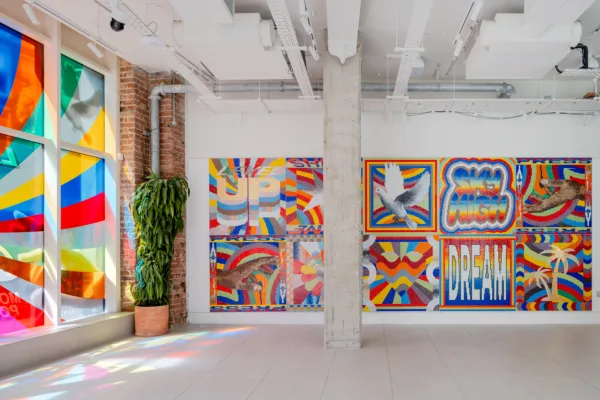
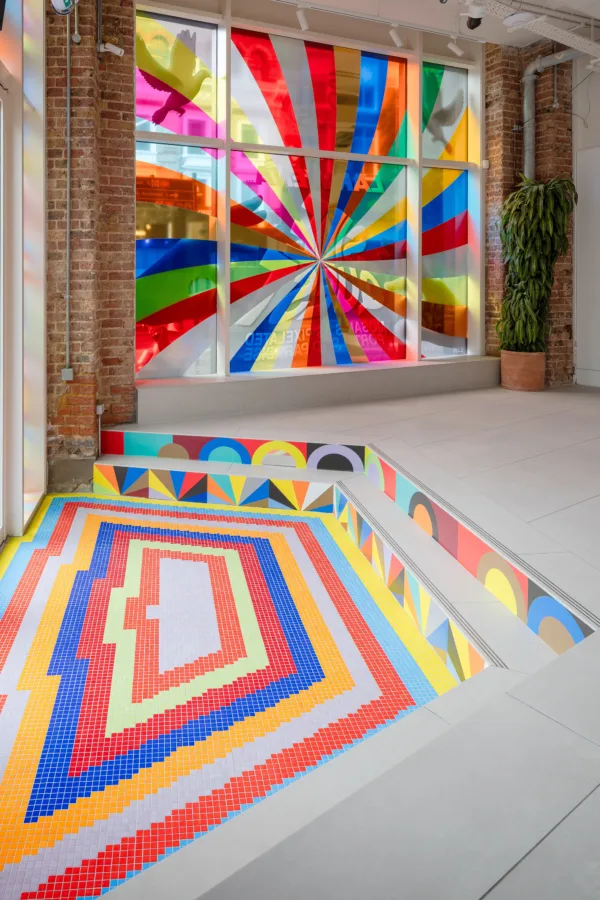
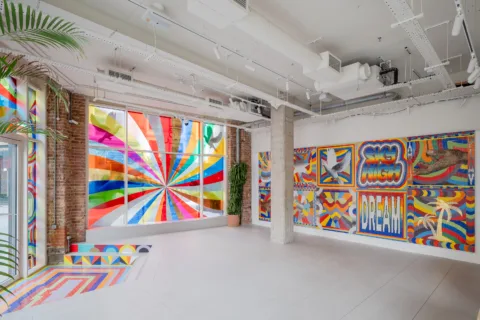
The core was Lakwena Maciver’s first major mosaic installation: a series of large-scale panels rendered in Solus’ Sidequest range – the installation shares its name with the range that made it. Lakwena’s bold, affirmative visual language was translated into a medium with a long and rich history. The work, designed by Lakwena, was realised in close collaboration with Italian mosaic specialists TREND Group, and hosted by Solus in the Clerkenwell showroom.
Each partner brought something the others could not: Lakwena’s graphic vocabulary of colour, pattern and the recurring hand motif; TREND’s mastery of glass mosaic across the 170 colours of the Sidequest range, and the heritage of Orsoni, the historic Venetian furnace TREND acquired in 2003 where smalti and gold-leaf mosaics have been made since 1888; and Solus, whose Clerkenwell showroom has become a year-round home for design-led collaborations, exhibitions and programming.
Sidequest: Mosaics as Pixelated Portals to Paradise extends well past the festival, remaining on view throughout the summer.
How it was made
The first conversations were about worldbuilding. Lakwena had been thinking about how, historically, mosaics were used to imagine: how Byzantine and early Christian churches deployed tesserae as portals into shared belief systems, gateways into other worlds. She saw a contemporary equivalent in an unexpected place: video games.
As Lakwena put it in our interview: “There are real parallels; this idea of building worlds you inhabit, that you engage with, that you use to escape, to imagine, to dream. It’s almost a human instinct to create worlds and then inhabit them. We do it now through video games; in the past it was rituals and festivals.” The mosaic and the pixel, separated by a thousand years, turned out to share a structural logic: a vivid whole built from small, repeating, independent units.
From there, Lakwena travelled to Italy to meet TREND’s makers in Vicenza, just outside Venice, and to visit the Orsoni colour library, the legendary room in Cannaregio where every Venetian smalti colour the furnace has ever made sits shelved and catalogued. Standing in that room with the makers themselves changed the work; the panels Lakwena drew on her return were tuned to the specific lustres and saturations the TREND palette could deliver.
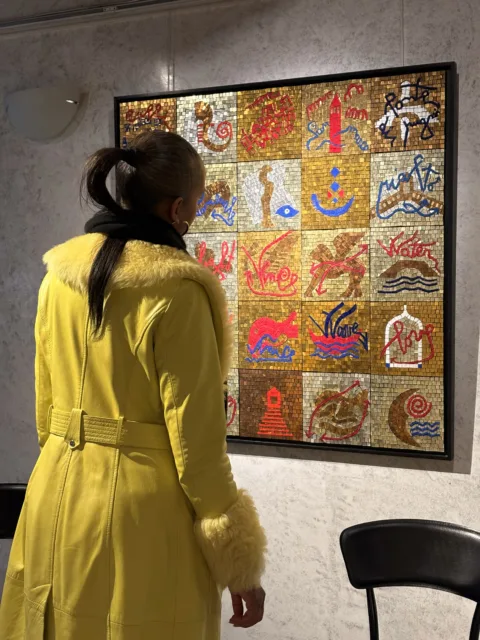
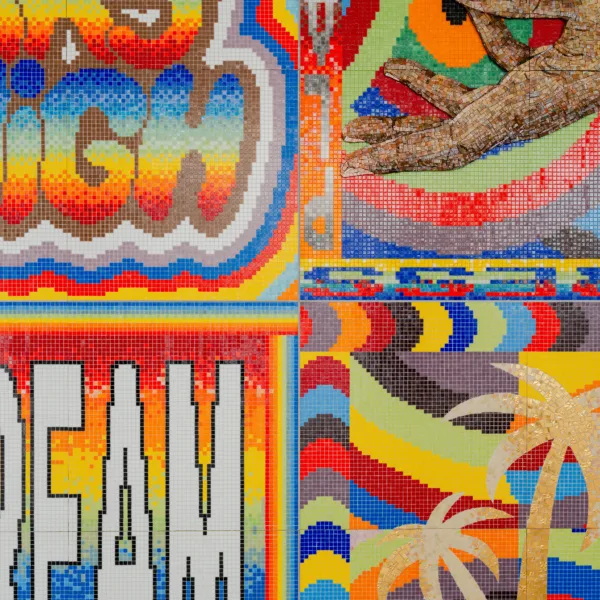
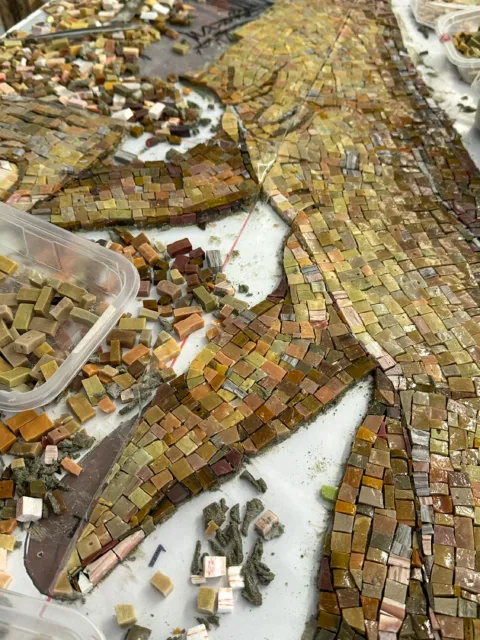
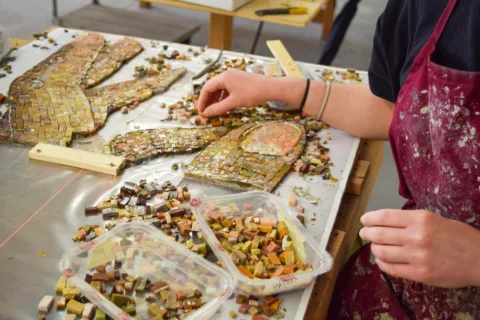
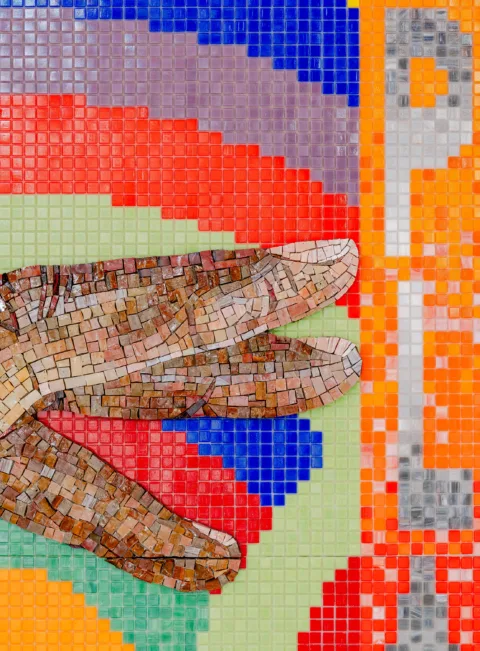
Translating those drawings into mosaic was a project in itself. Lakwena’s compositions were digitised and run through TREND’s programming process in two distinct formats. The first read her drawings pixel by pixel and laid them out as straight, gridded fields of colour, treating each 2cm tessera like a pixel on a screen. The second used 1cm tesserae, using software that simulates the judgements a human mosaicist would make: breaking forms along their contours and varying the orientation of the tesserae so that edges and curves carry their proper movement. Placed side by side, the two methods became part of the work’s argument: the drawing, whose initial management is entrusted to software but whose final realisation and installation involve artisan labour, just as the vital phase of colour selection is done manually. Furthermore, certain panels feature the insertion of 24K gold leaf mosaic, hand-crafted and hand-cut."
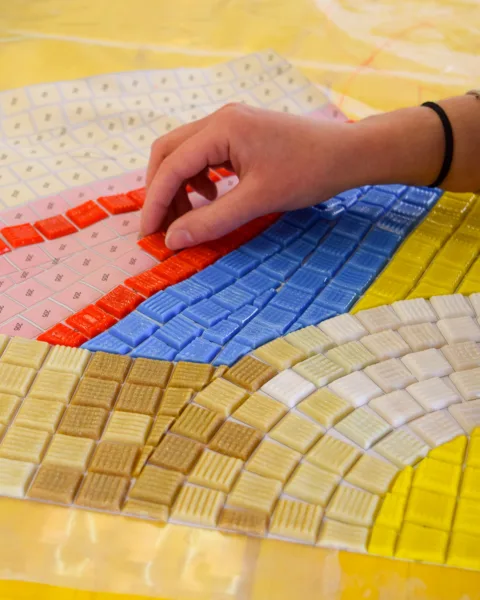
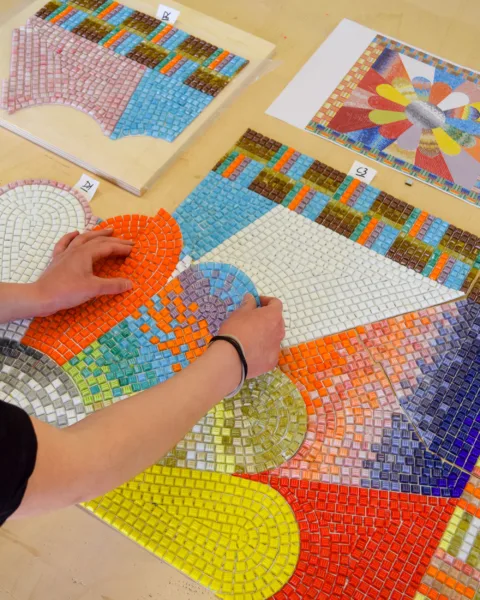
Alongside both, two panels featured images of reaching hands, which were made entirely by hand; a mosaicist at Orsoni interpreting one of Lakwena’s drawings directly with the human eye, choosing each piece, cutting where the line demanded it, and assembling the image as the tradition has always done. Because the work is large and the showroom is in Clerkenwell, the panels were built in segments in Italy, finished and packed, then transported to London for assembly on site by tile installers extraordinaire, Arcitile. This piece-by-piece logic, which is also the logic of the mosaic itself, allowed something architectural in scale to travel across a continent and arrive whole.
Around the installation: three days of activations
A programme of workshops, talks, food, drinks and live music animated the space across the three days.
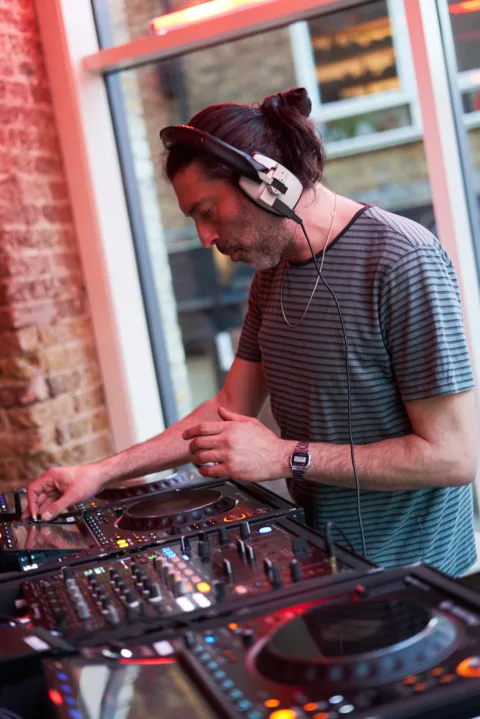
Tuesday opened with Lush’s Bath Bomb Masterclass, inviting guests to experiment with colour, scent and texture while learning more about the brand’s purpose-driven and socially conscious approach to business. As evening arrived, thematically inspired food by 5 Incorporated set the tone for the night ahead. Colour expert and founder of Luminary Colour, Anna Starmer, led a conversation on the joyful turn in colour, exploring the emotional and cultural power of colour to evoke feeling, optimism and human connection. The evening then moved into music, with Dr Leo Soul bringing a blend of neo-soul, jazz and lo-fi blues tones, before a DJ set by our very own Jo Sinclair rounded out day one.
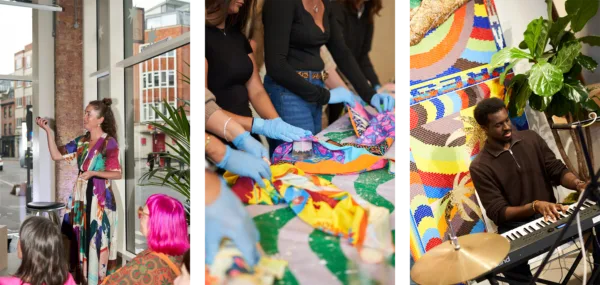
Wednesday featured the Mosaic Manifesto Through Colour workshop with Justine Fox, exploring applied colour psychology, symbolism, and placemaking in relation to the Sidequest collection. Food and drinks were provided by 5 Incorporated, followed by Phineas Harper’s Interdependence Day talk on collectivity and burnout - a powerful talk which examined the role of togetherness across design, urbanism, and society. The evening then moved into Touching Bass with Errol, Alex Rita, and Rohan Ayinde, whose eclectic sound and strong community ethos kept the dance floor moving late into the night.
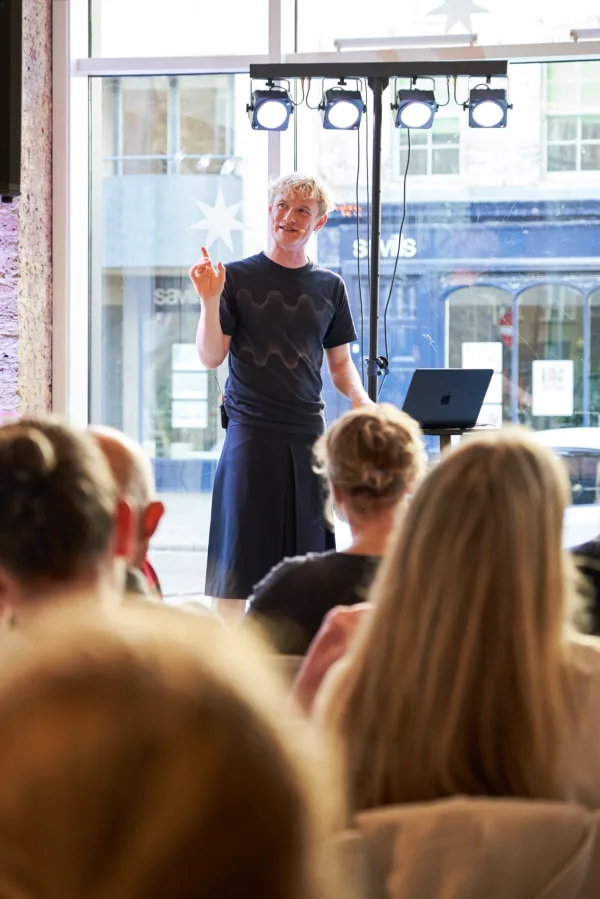
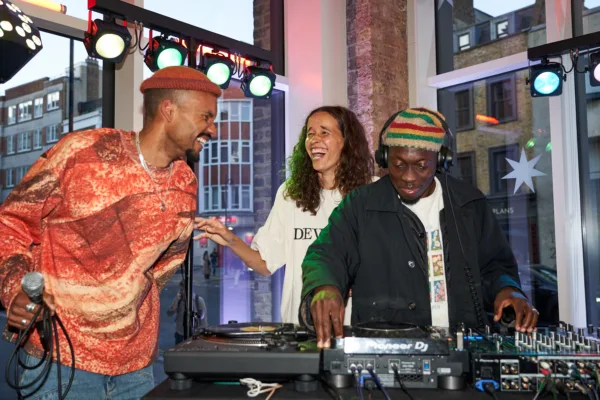
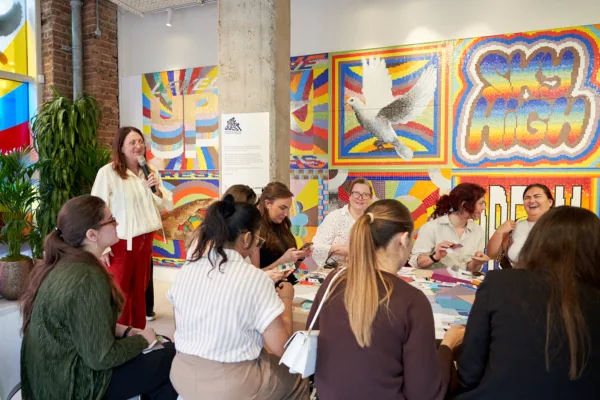
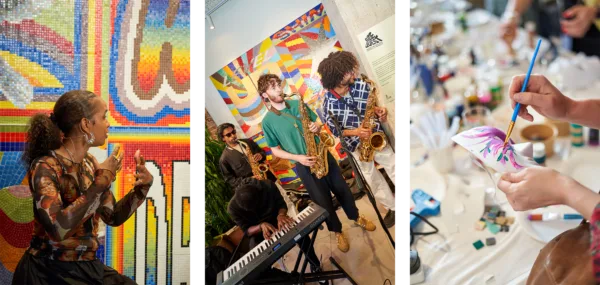
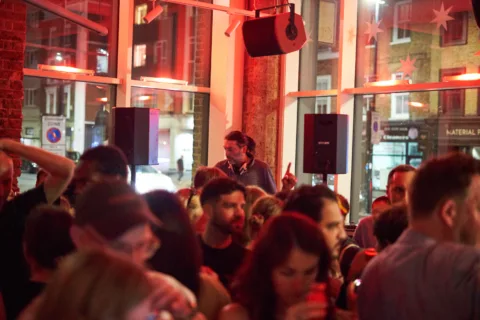
On the final day, a Venetian Mask Workshop by Crafty Jezebels invited guests into the playful and theatrical world of Venetian mask-making. Later in the afternoon, Five Points Project with Plumm delivered a fully improvised performance that carried electric energy from the showroom out onto the street. Food and drinks were provided by 5 Incorporated, followed by a talk by Lakwena, introducing Sidequest: Mosaics as Pixelated Portals to Paradise to the room. As the talk came to a close and the queue began forming outside, the final act of the night took over - a DJ set from pioneering producer Erol Alkan.
What comes next
Sidequest: Mosaics as Pixelated Portals to Paradise is far from over. The installation remains on view at Solus throughout the summer, and over the next three months further events will unfold around it. One panel sold during Clerkenwell Design Week itself, an early signal of how the work is being received.
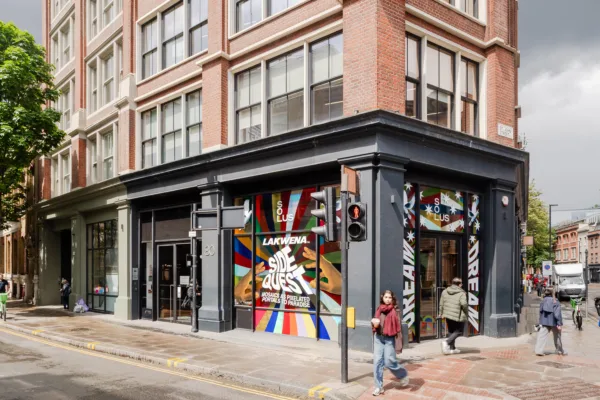
Visit the installation everyday Monday - Friday between 9am and 5pm at Solus, 80 Clerkenwell Road.
Watch this space. The portals are still open.
CREDIT
- Installation photography
Neil Perry
- Event photography
Joanna Wierzbicka
- Installed by
Arcitile
- Window vinyls
Puck Studio
NEWSLETTER
Get the latest news and updates sent straight to your inbox.


Meet the team: Domhnall McLaughlin
10th Jun 2026

Meet the team: Jade Whiteside
24th Apr 2026

Hearing the Eyes of the Skin
23rd Mar 2026

ReCover: designing for change, not waste
17th Feb 2026

Under the Table with Glenn Howells
16th Jan 2026

Solus celebrates 30 years
11th Dec 2025

Under the Table with Ian Simpson of SimpsonHaugh
22nd Oct 2025


Meet the team: Luke Bajic, Specialist Product Consultant
29th Sept 2025


Automatica: Design, Dispense, Deliver
3rd Jul 2025


Under the Table with Simon Allford
29th May 2025


Staples: What's on this Clerkenwell Design Week
23rd Apr 2025


Meet the team: Aaron Taylor, London Area Sales Manager
30th Jan 2025

Meet the team: Lauren Riley, London Area Sales Manager
29th Jan 2025


Goodbye to 2024
17th Dec 2024

Spolia wins the top spot at Mix Awards North
29th Nov 2024


Earth: Elements by Florim and Stiff + Trevillion
18th Nov 2024

Pantelleria – The Black Pearl of the Mediterranean
12th Sept 2024

Spolia longlisted for Dezeen Awards
12th Sept 2024


Clerkenwell Design Week 2024 – The Aftermath
30th May 2024

What’s on this Clerkenwell Design Week 2024
23rd Apr 2024

The story of the Ceramophone
23rd Feb 2024


Building Minds: In conversation with Frank Bruno
17th Jan 2024


In conversation with Juhani Pallasmaa
2nd Nov 2023


Solus Clerkenwell reopens its doors
31st Jul 2023

In conversation with Roger Tyrrell
21st Jun 2023

How can design drive optimism and change?
15th Jun 2023

Clerkenwell Design Week 2023
31st May 2023

Quarry, Clay, and Kiln: The story of Ketley
19th May 2023


What’s on this Clerkenwell Design Week 2023
24th Apr 2023

In conversation with Mauro Mazzi, CEO of Mirage
17th Apr 2023


How do materials shape positive experiences?
6th Oct 2022


How can the design industry lead with purpose?
13th Jul 2022

Solus sponsors Birmingham charity walkathon
7th Jul 2022

Meet Ken Graham, Sustainability Manager
23rd May 2022


Artisanal ceramics take centre stage for CDW Unlocked
22nd Jun 2021


Blu Ponti reflects Sorrento’s stunning seascape
3rd Apr 2021

Solus celebrates 25 years
16th Mar 2020
