Under the Table with Simon Allford
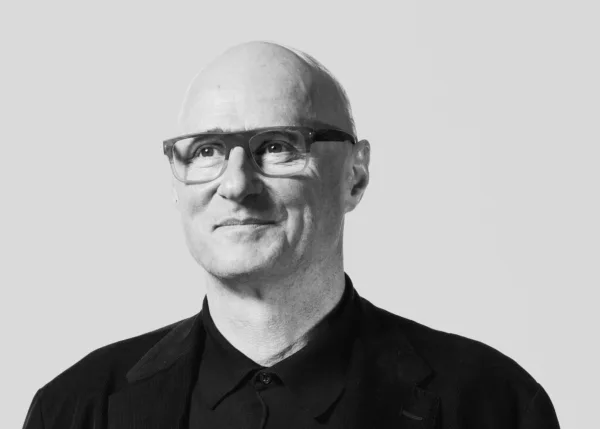
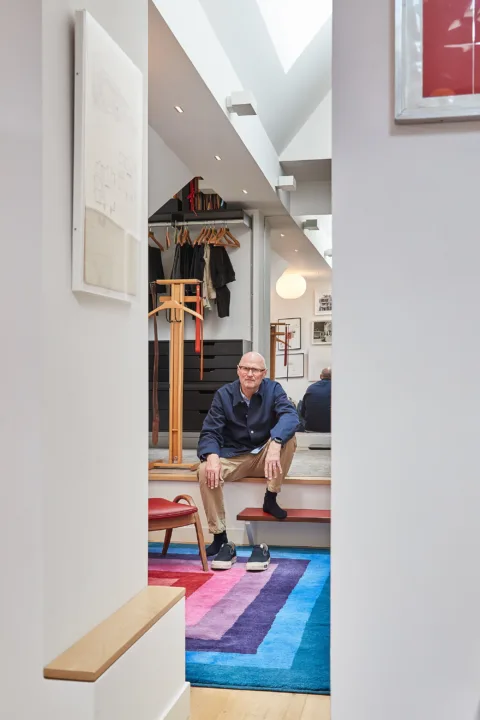
This interview with Simon Allford took place at the London studios of Allford Hall Monaghan Morris, the practice he co-founded in 1989 and has helped shape into one of the UK’s most influential architectural firms. A former President of the RIBA, Allford is known not only for AHMM’s widely acclaimed work across housing, education, health and workplace sectors, but for his outspoken advocacy for reform within the profession.
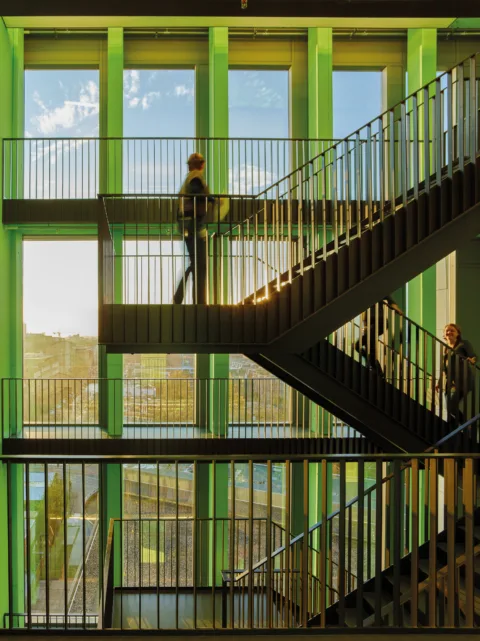
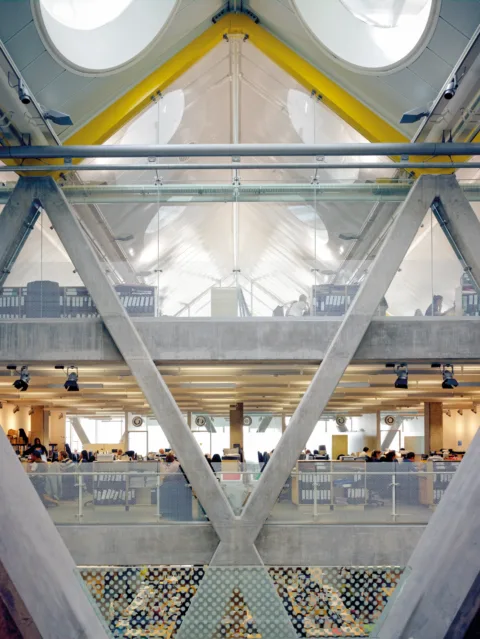
Conleth Buckley, Editor of Quarter, met at AHMM’s home at Morelands on Old Street. Before the conversation began, Simon gave Conleth a tour of the building: through the model shop, the materials library, and the layered additions that demonstrate the practice’s thinking in built form. He spoke with characteristic energy about reuse, constraint, and the life of buildings long after the architect has left the scene.
This interview forms part of Under the Table, a series inspired by a story told by Alvar Aalto. As a child, Aalto recalled crawling beneath his father’s kitchen table and experiencing a primal sense of architecture: enclosure, safety, prospect. Each interview in the series explores something of that early intuition: how our subjects first encountered architecture, what shaped their outlook, and what they’ve carried with them since.
Conleth
How did you come to architecture?
Simon
I came to architecture a bit later than some, around seventeen. I’d been thinking about doing history or English at university. I liked writing, liked language, but didn’t fancy being told what books to read or when to read them.
At the same time, I’d always been someone who drew. I didn’t take art O-level (my school only allowed eight subjects) but I kept drawing anyway. I realised I wanted to do something creative, just not in words. So, I said, “I’m going to be an architect.” which sounds like it came out of nowhere but actually my dad was an architect.
He was a bit surprised by this and said, “Well, it won’t be easy. You’ll never work for me (because that wouldn’t be fair) but if you want to do it, don’t let me stop you.”
It seemed a sudden and late decision, but looking back, it had probably been brewing. When I look back through my life, our family photographs, we’re always on a building site looking at architecture. If I look at family dinners, there's always a friend at the table who's an architect or an engineer from around the world.
As a young man, I was a keen sportsman. I thought I might be a footballer. I got to a decent level, but eventually realised some people were simply better. A watershed moment. I decided to get away from London and the world I knew, so I moved to Sheffield, where my dad and where my beloved Sheffield Wednesday were from.
Conleth
How has your northern heritage informed your identity?
Simon
I was a London boy who supported a northern football club, which immediately set me apart. It made you slightly different, and I think I liked that.
There was always a sense of otherness. My mum was from Redcar, my dad from Sheffield, but most of the family had passed away by the time I was growing up. It was another era. My mum lost her grandparents, my dad lost his parents. So, there was a kind of mythology around the north, stories of how tough life was up there. I found that connection fascinating.
As a kid I went north to watch football, and later I went properly, to live and study in Sheffield. Leaving London meant stepping out of the world I’d grown up in, which I realised, only once I’d left, was saturated with architecture. It was like being too close to a painting; you don’t see it until you step back.
At lectures in Sheffield, someone would mention modern architecture and I’d suddenly recognise the names. I’d think, Oh God, I know who that is. Not because I’d studied them, but because I’d heard their names around the dinner table: Mies, Cedric Price. Cedric and Frank Newby, the engineer, were my dad’s closest travelling companions. But I hadn’t clocked any of that at the time.
Getting away helped. People would ask me, “Are you related to David Allford?” And I’d say, “Only distantly.” Not because we didn’t speak, we talked constantly about architecture, football, life, but I didn’t want to be his son, not professionally. That was important to me.
Conleth
Did your parents’ socialist beliefs inform your desire to ‘create a landscape of choice’?
Simon
Yes, absolutely. My parents were socialist. Over time their views shifted, but the core idea stayed the same: a belief in meritocracy, in fairness, in the idea that talent should rise regardless of background. That was fundamental.
My dad grew up on a council estate in Sheffield. His father worked in the steelworks and died aged 53. There were no family connections, no safety nets. What he had was ability. He was made a partner by FRS York, who, before the war, had partnered with Marcel Breuer, no less. But that trajectory wasn’t about privilege; it was about what you could do. That mattered to them, and to me.
They were very clear that I wasn’t to lean on whatever connections they had built. That wasn’t how it worked. It had to be earned. They saw the old boys’ network for what it was—a system that locked people out—and they didn’t want me playing into it.
I think some of it came from the post-war mindset. The war was one of the great drivers of creative invention. A global fight against real evil, in a much looser, less regulated world. And when the war was over, people who would never have been allowed near power before had found themselves running things—organising, building, designing. That broke the hierarchy. For a while, at least, there was a genuine belief that a more equal society could be built. That architecture, like everything else, could be opened up.
That’s stayed with me. I’m not interested in reinforcing closed systems. I want to create a landscape of choice—so that people who might never see themselves in this profession can find a way in.
There’s a story I often think about from the war. Arup designed the Mulberry Harbours—huge concrete tanks that were floated across the Channel to create landing points for the D-Day invasion. Churchill sent him a note in 1943: “They must float up and down with the tide. The problem of the anchor must be solved. Let the details look after themselves.” And that was it. He gave him three months to make it happen.
Today, there’d be an audit trail, a peer review, a committee. Back then, you just got on with it.
When the war ended, people came back in their early twenties with this extraordinary level of experience. They’d faced real-world, high-stakes problems and made hard decisions under pressure. Suddenly there was a country to rebuild, and a sense—however fleeting—that young talent could shape a better world. There was ambition. There was room at the top.
That energy carried through into post-war architecture. But not all of it landed. Some of the most high-minded, visionary schemes ended up producing environments that looked like dystopia. The kind of places that worked better as sets for A Clockwork Orange than as places to live. There’s a lesson there. Aspiration and achievement aren’t the same thing. Passion isn’t a guarantee of quality or of relevance.
That’s something architecture always has to reckon with. The fact that you care doesn’t automatically make you right.
And it connects to something deeper: the idea that architecture doesn’t belong to architects. We’re trained to do it, but that doesn’t mean others can’t do it, and sometimes do it better. There are people inside the profession who don’t make good architecture, and people outside it who might. We have to be open, not just about who we let in, but about the very idea of who architecture is for, and who gets to make it.
One of the mistakes in that post-war period wasn’t the architectural language itself, but the failure to engage with the people who would actually build and inhabit those places.
Conleth
Do you think then that post-war Brutalism failed?
Simon
I have a lot of sympathy for the architects of that period. Most of them cared deeply. The failure, if you want to call it that, wasn’t about Brutalism as a style—it was about the speed, the scale, and the assumptions behind it. Too much was built too quickly. Too much demolished. Too many ideas imposed from above without understanding the layers of history they were building over.
And part of that was circumstantial. London was bombed out. If you watch a 1950s film like The Lavender Hill Mob, the city is rubble; empty plots, stagnant pools, desolation. So there was a kind of tabula rasa. People were trying to build a brave new world, often quite literally from ruins.
But that takes time. The Barbican, for instance, was unpopular when it opened. Now it’s fashionable. In some ways it works well, in others it’s still isolated, it hasn’t fulfilled the original idea of everyone moving up to the first floor. So it’s a ghetto, but one that’s beginning to work.
And that’s something architecture has to accept. Completion isn’t the end. When the building finishes, that’s when the real test begins. What might be unfashionable at first can become desirable later. Architecture moves on a long timeline.
But here’s the thing: just because you’re passionate about doing better doesn’t mean you will do better. Passion is not proof. The willingness to listen, to criticism, to doubt, even to your own uncertainty, is a vital part of architecture. Not because you always take it on, but because it keeps you honest.
You have to keep asking: what’s this for? Why are you doing it?
There’s always the danger of designing to impress other architects. That’s not enough. You have to believe in what you’re doing and be prepared to ignore fashion, but also stay open to being wrong.
And that’s where I think today’s government gets it wrong. When they talk about housing, it’s all numbers. “We’ll build 400,000 homes.” But that’s not the question. The question isn’t how many, it’s how good. It’s who for. The answer can’t just be volume.
Conleth
What qualities make a good architect and good architecture?
Simon
We talked earlier about creating opportunities and a level playing field. But architecture itself is also collaborative. You’re working with other designers, with clients, builders, makers—and ultimately, with society. Because the building always outlasts the people who commission it. If it’s good, it becomes a long-term asset for a community. It adapts. It evolves.
That’s where generosity comes in. And openness. You’re not just a sponge, reacting to whatever people throw at you. But you do need to listen. When you hear, “Can it be blue instead of yellow?” think What does that comment tell me? What might this building need to be, beyond what I’ve imagined? You reflect it back through the architecture.
Ideally, a building has enough character that people want to use it, enjoy it, and change it. That it becomes theirs—without weakening the idea behind it. I’ve seen architects bring a van full of furniture to their project to stage a space just right and then leave. And the moment they’re gone, real life moves in and the illusion falls apart.
We’ve always taken the opposite view. Design something that real life can happen in, and let that life improve it. Let people use it in ways you never planned. That’s when it’s working. That’s when it gets better with time.
When people at Pessac added shutters, cut arches through Le Corbusier’s clean concrete forms, critics saw it as vandalism. But he just said, “Life is always right.”
So, generosity is also physical: light, air, volume. Give the building room to grow. Design for a loose fit, not a fixed idea. The phrase is “long life, loose fit.” That flexibility lets life take over. And that’s a good thing.
We’re reusing buildings now—but reuse is not new. It’s what people did before the post-war obsession with newness. Historically, everything was recycled. Materials, ideas, buildings. The idea that every innovation is new is usually nonsense. I’d tell someone in the office about an ingenious new government scheme, and Victor Kite—a brilliant guy who worked with us, and with my dad before that—would say, “Yeah, we called that nominated subcontractors in the ’60s.” It’s all been done before, just under different names.
So, you learn from the past. Learn from what worked—and what didn’t. Post-war housing wasn’t all bad. But the failures happened when people didn’t reflect. We don’t know what mistakes we’re making right now—we like to think we’re getting most things right—but of course we’re making mistakes. The key is how you manage them.
When I visit a project, I always notice things that aren’t as good as they should be. Not just details—organisation, decision-making. Not because I’m being negative, but because the next one should be better. If each building improves by 3%, over ten projects, you’ve made serious progress. In light, in air, in joy—whatever it is.
Conleth
In what ways can architects learn from historical and vernacular architecture?
Simon
When I was teaching at the Bartlett, there was always a focus on the now—what’s happening today, or in the past 15 years. And that makes sense. We live in the present. But I’ve always argued for what I call the long history of architecture—starting from the pyramids, through Athens and Europe, and across the world to Africa, Asia, the Americas. How people have made buildings over centuries. Even the old-school survey course—warts and all—is incredibly useful.
Because what often gets passed off as innovation today is rarely new. You hear about some cutting-edge material or design strategy and then discover it’s 2,000 years old. Like the lime in the Pantheon’s concrete—it self-heals. That would be marketed now as futuristic and green. But it’s Roman. So much of what we think is radical is actually just unremembered.
The point is: history teaches intelligence. It gives you shoulders to stand on. You can either climb up that way, or spend your whole career reinventing the wheel—only to realise, much later, that the answers were there all along.
Architecture also trains you to see. Whether you’re walking, on a train, or just looking out a window, you start asking questions: How was that built? Why is that working? Why isn’t it? You’re not quite an anthropologist, but you start observing how buildings are made, used, reused. You start noticing details and clues—especially in vernacular architecture.
Look at Morocco, or balloon-frame houses in North America, which they used to pick up and move. We did similar things in medieval Britain—wattle and daub infill with permanent timber frames. These traditions still have lessons in how to build flexibly, how to think practically.
But then came the post-war era and the rise of regulation. A lot of it was well-intentioned—focused on health, air quality, better conditions. But over time, layer after layer of rules built up. And that started to get in the way of some basic principles.
Take the air-conditioned office. We decided the right temperature was 21 degrees, plus or minus half a degree. Then we glazed the buildings—so they overheated. Then we added more tech to fix the problem. Now you need systems to manage the systems. It’s a self-perpetuating cycle.
Whereas if you go back to first principles—like putting solid into a wall—it doesn’t overheat. It makes the view better, more framed. You need less cooling. You need less tech. Most people don’t understand the tech anyway—including those meant to operate it.
When we designed White Collar Factory, we had a long think about how buildings perform. A lot of them are like high-spec cars—packed with technology that looks impressive but barely gets used.
What we really need is the architectural equivalent of a 2CV. Something simple, reliable, and efficient. A building that uses most of its systems most of the time. Not something with 100 features that only 5% ever engage with. It’s better to have 5 good features that get used 90% of the time. That’s proper utility. That’s real design.
You need to build in just enough capacity for the unknown—without over-designing the whole thing into bland neutrality. Because if a building tries to be all things to all people, it usually ends up being nothing to anyone.
Good buildings have constraints. And those constraints can be joyful. They give people choices. A rough bit of the building might become someone’s workshop, or their favourite spot to eat or think. The big open space might become something else entirely. Life isn’t one fixed activity. Buildings shouldn’t be either. Difference is what gives architecture its future.
Conleth
Colin Chapman, founder of Lotus, said “Simplify, then add lightness.” Does the principle of simplifying inform your practice?
Simon
Yeah. Asking a difficult question of yourself, or of the project is always a good place to start. And we have a joke here: if you come out of a design review and everyone’s completely happy, it probably isn’t very good. You want people to be challenged. And you want to have to think about your response. That’s how you know you’re moving things on, not because you're trying desperately to move things on, but because you're thinking quite hard about how to do it a little bit better.
It’s interesting you mention Lotus. Chapman’s idea was to gain speed through lightness, not horsepower. In the 1960s, architecture did something similar. Cheap energy meant we could build light, flexible, demountable buildings. Great in theory. In practice, people rarely moved the panels or adapted the spaces. It was a nice idea, but it didn’t really happen.
Then, after the OPEC oil crisis, we shifted. Energy was expensive, so we started making buildings heavier, to trap warmth inside. That meant putting more and more energy into the physical fabric of the building. And now, we’ve come full circle. We’re asking: if the grid is going green, is that heavy embodied carbon investment justified? If operational carbon is dropping, maybe we shouldn’t overbuild the envelope. Maybe we need to rethink again.
It shows how quickly things change. Across my career, the logic around lightness, heaviness, operational carbon, embodied carbon—it’s all shifted. And I don’t think the profession has fully caught up.
Buckminster Fuller had this amazing idea: cover Manhattan with a geodesic dome to create a single microclimate. He was making a point—treat the city as a closed system, a spaceship with finite resources. And that mindset still matters. We need to think like systems designers.
But we also need to stay flexible. Too often, sustainability becomes a belief system. A mission statement. That’s dangerous. Not because you shouldn’t have values—but because your values need constant testing. The context is always shifting. Technology changes. Energy supply changes. What seemed right five years ago might not be right now.
That’s why architects don’t own architecture. Society does. The people who live and work in our buildings do. Our clients do—especially when they’re building for the long term.
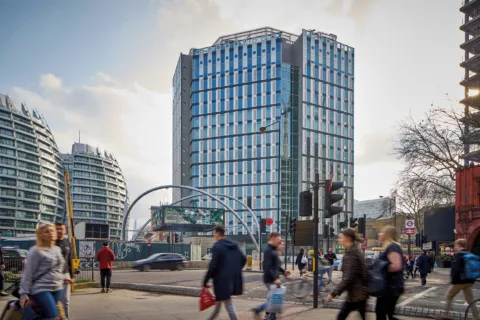
We call it “forever architecture.” Most of our clients don’t build to sell; they build to keep. Schools, housing, healthcare, workplaces—they’re all mixing now. So we talk to them about longevity: how the building will age, how it can adapt, how it can stay useful. That’s when you can really think about bigger ideas—about materials, climate, joy.
Because if the client’s invested in the future, you can design for the future. If it’s just a flip-and-sell, there’s no stake in what comes next. And that’s when architecture becomes short-term and forgettable.
Conleth
How do you know when a client or project is the right fit?
Simon
When I was a young architect, there was a twice-president of the RIBA, Erwin Luder—a south London lad from Brixton—who gave us a bit of advice that stuck with me. At the time, there were four of us, no money, no work, and anyone who came through the door was a lifeline. But he said, “If a difficult client walks in, write them a cheque for £20,000 and ask them to leave—because you’ll lose a lot more if you keep them.”
Now, we didn’t have £20,000, obviously. But the point was right: you can only make good architecture with and forpeople who care. That starts with the client. And it carries through to everyone involved in making the building.
You have to build a team. That doesn’t just mean us and the client—it’s the contractor, the trades, the fabricators. Everyone. And for that to work, people need to understand not just what the building is, but why. So we always say: when you’re presenting to a contractor, don’t just hand over the drawings and say, “Make this.” Tell them what’s driving it. What’s the idea? What’s the economy of materials? What are you trying to do—elegantly, structurally, over time?
Because if someone’s going to spend months, maybe years, working on something in cold, wet, difficult conditions on site, they need to understand the purpose. They need to believe in it. That shared vision carries everything through.
I’m not romantic about it. It’s hard. Sometimes we’re saying to the builder, “We need to deliver more for less.” So it’s a balancing act—of ownership, responsibility, risk. But that’s the human side of it.
We often talk about the human side of a building after it’s finished. But the process of making it is just as human—and just as remarkable. You walk onto a site and there are 500 people from all over the world. Some local, some flown in to deliver one key component. And they’re all working to bring this one-off thing into existence.
People say buildings are expensive—and they are. But it’s not like cars. We don’t make 10,000 of the same model. Every building is a prototype. And most of the time, we’re working in historical cities, not clean-sheet contexts like Milton Keynes. You’ve got constraints underground, constraints in the air, layers of history pressing in. And somehow, within all that, you have to hold a vision—and bring people along with it.
It’s an opera. And like all operas, it can go brilliantly—or go completely wrong. The trick is getting everyone to believe in the music.
Conleth
You’ve spoken elsewhere about the galvanising effect of a health scare. Would you mind telling us about that?
Simon
I’ve always been pretty sporty, but I live life fairly large too. One of my clients—who owned this building, actually, and was involved in several important projects—told me, “You should get a well-man test.” I’d been doing a lot of running, felt fit, thought nothing of it.
Then I got a call. Didn’t recognise the name, was in a meeting, told the receptionist, “Don’t know her. I’m busy.” She came back and said, “She says she’s a doctor.” It was the woman who’d done my test. And then she delivered the famous line: “I don’t wish to alarm you, but you could drop dead at any moment.” Which, I have to say, is quite an alarming line to receive in a meeting.
And life’s tricky. I had a session that afternoon at Richard Rogers’ office about a live project. And I thought, What do I do? Well, I’m going to go to the meeting!
Later that evening, I told my wife, “I feel like an extra in Scanners—my head could explode at any minute.” And then came the next dilemma: Sheffield Wednesday were playing Brentford in the play-off semi-final at Hillsborough. I told her, “If we score, I’ll jump up with the crowd and that’ll be it—I’ll drop dead.” She said, “Well, if you’re going to die anywhere, die there.” As it happened, we won. Then we won the second leg. Then we went to Wembley and won that too. And I’m still here. So things worked out. But for six or eight weeks, I was in limbo—waiting for tests, scans, answers. Eventually they said, “At worst, you’ll need a pacemaker.” And I thought, Fine. Crack on.
It definitely shifted something. I went from feeling healthy at 42 to being told I could go at any moment, to then realising it was manageable. That arc puts a lot into perspective.
I’ve tried to treat it as a lesson. I like life. I lost a sister to a brain tumour. It makes you think Whatever problems I’ve got, they’re nothing compared to being very, very ill or dying prematurely in your life. So, for fuck’s sake, enjoy it.
It can’t be a hedonistic joyride. But you’ve got to try to enjoy the opera—and even the problems. Make it part of the adventure. Otherwise, it’ll wear you down.
CONLETH
You’ve spoken about how you see AHMM as a kind of college or university—a place where people learn, grow, and move through. Does that come from the values of the four founders?
SIMON
Yes, definitely. The four of us—Paul Monaghan and I studied at Sheffield; Jonathan Hall and Peter Morris were at Bristol—we all ended up at the Bartlett for our diplomas. But we’d done our degrees elsewhere. We were outsiders in that sense. The school had a very particular way of working, and we weren’t especially interested in doing things that way.
Fortunately, we had a tutor who said, “No, man, do your own thing.” So we did. We set up a self-directed unit called The Fifth Man—there were four of us, and we liked films. The idea was that the project itself became the fifth man. It didn’t belong to any one of us, but to all of us. It had its own identity.
At the same time, we believed architecture needs an author. So we didn’t design by committee. Each of us took a building within the project and developed it independently. Then we’d Xerox the parts together—plans, sections, perspectives—and overlay them. That way, the individual ideas were tested in the context of the collective. And that basic model has run through the practice ever since.
It’s why teaching has always been part of what we do—at universities, in schools, in our communities. Not as a form of “giving back”—I don’t like that phrase—but as mutual exchange. That’s how learning works. That’s how a practice works.
Many of us have worked together for decades. The four founders have been working together for over forty years, since we were students. But the idea is: you’re together when you want to be, when there’s shared purpose. And if someone decides to leave—to do something else, somewhere else—that’s fine. That’s healthy.
I don’t think a workplace should be a club. Clubs are cliquey. A practice should be open—like a school of life. People come and go, from all over the world. Some stay, some return later as collaborators, clients, friends. It’s not something to be afraid of.
It always struck me as a bit sad when firms are terrified of people leaving. It’s like they’re afraid of what that departure represents. But someone leaving makes space for someone else—someone younger, someone different, someone who brings new energy or insight.
No one is indispensable. Not even the founders. We’re in our sixties now. We talk about succession, about what comes next, but there’s no perfect clarity. There never is. Eventually, one of us will decide to step away—or just drop dead—and that’ll be that. What matters is that the organisation can keep going. That it’s built to thrive, not to depend.
That’s the model: of architecture, and of life. Even in football—someone you thought was irreplaceable leaves, and the team finds a new way to play. That’s exciting. It brings renewal.
And when people bring their own experiences—cultural, technical, intellectual—it makes the work better. Someone sees something differently. That difference becomes part of the conversation. That’s how good architecture happens.
CONLETH
What does your daily practice look like? How are tasks divided between the four of you?
SIMON
Over time, we’ve each developed different strengths. Paul Monaghan and I run large design studios—each of us working with between 100 and 200 architects. That’s where our energy goes: making buildings.
Jonathan Hall leads on review, compliance, monitoring—all the heavyweight systems that keep the practice robust. He’s not doing it all personally, but he’s shaping the culture around it, making sure it holds together.
Peter Morris acts as managing director, with a broader organisational overview. Less about architecture per se, and more about how people work together. How you make that collaboration successful—not just structurally, but humanly.
That said, there’s plenty of overlap. We all attend design reviews. We all engage in discussions about culture and direction. It’s not four silos. It’s four people with different lenses, all focused on the same thing.
My passion has always been making buildings. My mum used to say, “Darling, you’re ramping up just as your father was ramping down.” And she was right—he’d been given Gatwick Airport when he was 28. Sent off by FRS York to figure out what an airport even was, then invent one for the UK.
I, on the other hand, started out doing loft conversions in West Hampstead. I used to advertise in the Ham & High. One of my first commissions was putting a window in an existing wall—and I was thrilled. That felt like progress.
Architecture offers constant opportunities to test yourself—your thinking, your values, your skill. These days we work at all kinds of scales, in different locations, across time zones. It’s a kind of toy shop of possibilities. Not something you take lightly—but something that keeps you going. Keeps you curious. Keeps you moving forward.
I always say: the next building is the most interesting one. Not the last. We’ve had buildings win Test of Time awards—and that’s meaningful. It’s important to look back. But if you find yourself thinking, that was my best period, that’s a warning sign. Hopefully, your best work is still ahead.
We might be wrong, of course. Sometimes a project you believe in fades, and one you thought was minor ends up enduring. But that’s the game. The real critic isn’t the architecture press. It’s history. It’s time. A building’s true value only becomes clear 20, 30 years after the fact. The thing that wins awards today might disappear tomorrow.
So don’t play to fashion. Fashion’s fickle. The test is what lasts.
CONLETH
Tell us about these models. What are we looking at here?
SIMON
Model making is a big part of our culture. It’s not just about representation—it’s a way of thinking. Most of our model makers have been with us for a decade or more, like many of the architects. So they don’t just understand how to make models—they understand how we make buildings.
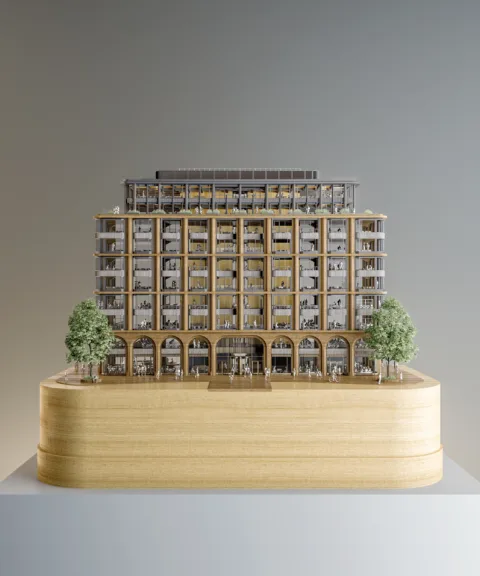
Some of the models in this room are early studies, quick maquettes. Others are more refined. One of them is Belgrove House, a project we’re working on for Precis, a Canadian family firm developing the site for MSD—Merck, the global life sciences company. It’s right opposite three Grade I listed buildings: King’s Cross, St Pancras Chambers, and the British Library.
We were told by a key figure in the planning process that the building not only had to function, but had to be a symbol—a building that reflects its place in what people now call the “Knowledge Quarter,” with the Crick Institute nearby, links to Cambridge, and an extraordinary concentration of academIc and cultural capital.
That was a huge challenge. But it also gave us a kind of freedom. We could say to the client: This needs to be more than just efficient—it needs to stand for something. And that didn’t mean giving it a look. It meant finding a set of principles the design could follow.
For us, that meant an economy of materials, long-term flexibility, and what I call the architectural promenade—the way you move through and experience the building. Belgrove has a fully public ground floor. We absorbed the tube station into the base of the building, which completely changes its relationship to the city. It’s public, both operationally and conceptually.
The lab floors are highly functional—five-metre heights, long spans, almost like railway sheds. But above them is something completely different: garden terraces, green collaboration spaces, biophilic elements. Triple-glazed skins with planting between. The labs, the workspaces, the collaboration gardens—each has its own architectural character.
Then there’s the expression of systems. This is a lab building—so moving air is a big deal. We made that visible in the architecture. It’s not new—Louis Kahn did it—but this was about giving that idea a London expression, using contemporary methods. We explored cross-laminated timber, pre-fabricated components, triple skins, garden balconies.
Now the building’s on site. That’s the real excitement. We’ve modelled it in software, we’ve modelled it physically, we’ve seen it a hundred different ways—but once it starts coming up in real life, you discover things. Things you didn’t expect.
And in the best-case scenario, it’s not just what you imagined—it’s better.
CONLETH
You’ve spoken about the idea of a project as a long-term undertaking. Can you say more about how that works in practice?
SIMON
Projects like Belgrove House can take ten years, start to finish. People come and go. A few of us are constants, but many others contribute along the way. For that to work, the project needs an idea that’s clear enough to be understood—and owned—by everyone involved. Not a stylistic gesture, but a deeper organisational logic. Something that defines the building over time.
We had a similar experience with Lansdowne House, a project on the edge of Berkeley Square. Historically, the site was a garden connecting all the way to Piccadilly. In the 1930s, the Curzon Street cut-through lopped off the front of the Lansdowne House Club—Selfridge’s old home—which is why that building is so oddly thin.
Since then, there’ve been two more buildings on the site: one a car showroom with flats—glamour and technology of its day—and later, a postmodern office block from the ’90s. It had an atrium, five concrete cores, and not much grace. I never liked it, but the site is extraordinary: four street frontages on one of London’s great squares.
We entered the competition with a clear position. This would be the third building on the site—and it needed to be the one that stayed. A forever building. So the question became: what kind of building has that staying power?
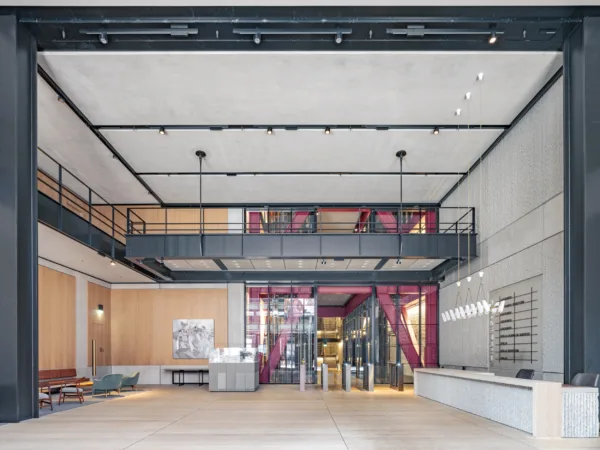
We proposed something Auguste Perret might have described as a 20th-century warehouse—though we were standing on some of the most valuable land in London. A warehouse, yes—but with purpose. Robust, adaptable, and elegant.
We designed long-span concrete floors held up by oversized columns—a sway frame. No reliance on cores for structure. Instead, we dropped the circulation—stairs, lifts—into a central courtyard as lightweight, replaceable elements. That gave us flexibility and clarity. The building stands up on its own.
And because the frame does the work, the façade becomes free. Le Corbusier said the frame frees up architecture. But too often, that leads to façades that feel like wallpaper—floating, uncommitted. We didn’t want that. So we made the frame visible.
The oversized columns are expressed on the exterior, cold bridge and all—we solved that with the right technology. The windows go into walls, not across them. Big windows, yes—but grounded in mass and rhythm. There are balconies, terraces, gardens in the mix.
A journalist described it as a new kind of Brutalism. For a kid of the ’60s, that’s about as good a compliment as you can get.
But it’s not about style. The idea isn’t plucked out of the air to sound clever. It comes from the problem you’re solving. We work best when we’re working within constraints. And London is probably the most constrained city in the world—planning, regulation, construction. That’s the challenge. And that’s the joy.
CONLETH
You’ve said before that constraint is useful to you as an architect. Could you say more about that?
SIMON
Absolutely. One of the joys of working in London is how constrained it is—regulation, planning, layers of history, construction logistics. It forces you to think harder. It’s like life drawing. Every artist, even the most abstract, returns to that discipline. And for us, building in London is the architectural equivalent. You refine your craft against resistance.
Then we go to somewhere like India, where the rules are different. Not gone—but looser. And we don’t throw away our discipline. We bring it with us. But we also create our own framework—our own internal logic of constraint—because that’s what gives the work rigour. That’s where the thinking happens.
It’s like that old line from the First World War: “Gentlemen, we have no money. Now we must think.” No money, limited materials, a carbon problem—these are all useful constraints. They sharpen the mind. They stop you from sleepwalking through a project. The only danger is when those constraints become obsessions. You stop thinking. You miss the obvious.
That’s why I don’t believe in obsessions. I believe in testing your ideas, pushing them, being open to criticism. It makes the work more robust. More real.
And that’s what excites me about what comes next. The long game. Buildings that last. Because our long-term client isn’t just the person funding the project—it’s the future. It’s the people who’ll use the building in 20 or 50 years. And the 99% who’ll never enter it but walk past it every day. I’m not trying to entertain them—but I want to offer something. Maybe it’s light, maybe shade, maybe rhythm or modelling on the façade. Maybe just the first six metres. Most of us never look up anyway—including architects.
That long view is built into how we work. When we were young, there was this idea that architects should specialise—be either designers or deliverers, work in education or retail or housing. But our view was: our specialism is buildings. And buildings are long, messy things. They change use. They change hands. They evolve. So you have to think across the lifespan—and across all stages.
We’ve already specialised out of engineering, surveying, town planning—we’ve chosen buildings. So let’s do them properly. Let’s think about the whole process—from concept to construction—and what happens after. Every time you make a building, you learn something new. About a pile cap. A hybrid frame. A material. That becomes the constraint you build within next time. And hopefully, you make something better.
That’s why we say: the next building is the most important one. Not the last.
conleth
You’ve spoken before about architecture’s broader role in society. How far do you think architects can—or should—engage in the political and economic forces that shape the built environment?
simon
It’s easy to get caught up in what architecture is—buildings, plans, materials. But the real work, often, is what surrounds the building: infrastructure, policy, economics, power. And in the UK, that context is messy.
Take High Speed 2. It’s taken 20 years not to start, and it costs double what it would in France. That’s partly because, despite their revolution in 1789, the French haven’t moved their democracy much further on—when the president wants something done, it gets done. Here, we debate with every parish the line passes through. By the time we’re done talking, there’s no money left to do it properly.
That’s the imperfection of our system—but I’ll take it over the alternative. Democracy may be slow and frustrating, but it’s still the best system around. As Churchill said, “Communism is the equal sharing of misery. Democracy is the unequal sharing of happiness.” Simplistic, but not wrong.
The real risk isn’t that we argue—it’s that we argue to a standstill. That nothing happens. We talk about a housing crisis, but as a friend of mine once said, we don’t have a housing crisis—we have a people movement crisis. There are enough homes, but people don’t move. Stamp duty is part of it. People don’t downsize, so we end up with elderly couples in five-bed houses and five-person families in two-beds. It’s not just a planning problem—it’s microeconomic.
In the US, people move across the country for opportunity. Here, it’s cultural. My mum was from Redcar. Middlesbrough has lost ICI, lost the steelworks. The economic reasons to stay are gone, but the emotional reasons remain. So we need to think about revival—and it probably starts with infrastructure. Connect people, connect places, give regions a future.
We talk about the “northern powerhouse,” but our system is still incredibly centralised. London is its own global economy. And yes, that wealth feeds outwards—but there’s talent all over the country. What we lack is connection. Once you lose shipbuilding in Sunderland, or steel in Redcar, you don’t get it back. But rearmament—sinister as the word sounds—might lead to something else: re-industrialisation.
Because we don’t really make things anymore. We assemble pieces. We talk about being a knowledge economy, but I’ve never bought it. Knowledge is essential—but so is making. Craft matters. We make buildings. You don’t theorise your way through that. You lay it, lift it, build it.
People in finance sometimes tell me, “I make money, but I’m not sure what I do.” There’s something powerful about making something real—cars, tools, lights, medical devices, buildings. I think the rebalancing of our economy—less London-centric, more industrial—could be a positive shift. But no one in government seems to outline the bigger picture.
That’s partly democracy too. Politics is shaped by soundbites now, not vision. People talk about “conviction politicians,” and I think—shouldn’t all politicians have convictions? But a lot of them feel like mirrors, reflecting whatever social media wants in the moment.
And maybe it’s not their fault. I sometimes wonder what happens when people get into power. It’s like they’re taken into a blank room and told, This is what’s happening. Now go out there and pretend.
conleth
What’s your advice for young people thinking about entering architecture or design?
simon
If you’re interested in the world I work in—the world of architecture—it’s an incredibly engaging and rewarding career. So first of all: be optimistic. Engage with it.
There’s this idea that architectural education is long. But it’s not really—three years, plus two, and soon it may be three plus one. Some of us are working on that. There are new earn-and-learn models coming through. Historically, no one studied architecture in a classroom—they were articled, they learned by doing. We’re trying to bring some of that back.
And I always say: don’t study architecture because you think you have to be an architect. Study it because you find it fascinating. No one who does a philosophy degree says, “Oh, I dropped out of philosophy.” But you hear people say that about architecture. I’d say: don’t. You studied it. It changed how you see the world. That’s enough.
Architecture education touches everything—people, place, science, culture, history, systems, creativity. That’s why so many people who study it go on to become filmmakers, writers, designers, thinkers, builders. Around 40% of people who study architecture don’t go into practice. That’s not failure. That’s success. That means it’s working as an education.
Even if you stay in the field, you don’t have to be an architect. Some of the smartest people I work with started in architecture, but moved into construction or development or other parts of the process. They still have a passion for it—they just found a different way to apply it.
And even if you study it and never touch it again—it’s still three brilliant years. It teaches you how to understand situations. How to define a problem. How to ask: what’s really going on here? What’s driving this? How might we do it better?
That’s what architecture is. It just happens to use buildings as its language.
There’s a Cedric Price line I love—he said that after four meetings with a couple who wanted an extension, he realised: “You don’t need an extension. You need a divorce.” And that’s the point. Architecture isn’t always the solution. Sometimes the creative act is not building.
It’s the same for clients today. Sometimes the best advice is: don’t build anything. Rethink how you’re using what you’ve got. Rethink the timetable. Rethink the brief. That’s still architecture—it’s just not bricks and mortar. Because putting bricks and mortar together isn’t a creative act unless it has purpose.
So I’d say to anyone thinking about this path: don’t come in with a fixed idea of what kind of architect you’ll be—or whether you’ll be one at all. Come in with curiosity. Let it lead you.
It might lead you to policy. Or planning. Or craft. Or teaching. You might redesign regulations. One of the things I’ve said before: the GLA made north-facing flats illegal. But I live in one. It gets no solar gain. My blinds are always up. The south-facing window? Too much solar. The blinds are always down. The point is—designers should be looking at these things, challenging assumptions, testing regulations, rethinking systems.
Constraints, if you’re paying attention, are often where the opportunity lies. Not because they make life easy—but because they make you think.
And if architecture does nothing else, it teaches you how to think. That’s no small thing.
conleth
How did you meet Sam Frith? Tell us about that relationship.
simon
I work on a lot of projects, with a lot of brilliant specialists—and I don’t always get to dive into the detail as much as I’d like. One day Steve Taylor said to me, “You should meet this guy, Sam Frith.” I didn’t know who he was or where he was, so I told my PA to find out. Turned out he was on Hatton Garden.
So I said, “I’ll just pop in, have a coffee, see what he’s about.” I stumbled through this big timber door—probably said “fuck it” as I went in—and I had a black eye at the time, which I think Sam remembers. I was wired, between meetings. But I walked in and thought: this place is magic.
It wasn’t a showroom, not in the normal sense. It was a space full of ideas. You opened drawers, there were glazes, surfaces, unexpected materials. It was like a toy shop. He’d worked with Simon Astridge on the design, so it was clever—it wasn’t just a space about materials, it was a material. The courtyard was tiled in terrazzo and felt like a room in itself. It was architectural, but also totally personal. It was Sam’s project. His mind laid out physically.
I said to my friend and long-time client Simon Silver—whom I’ve worked with for 30 years—“Just go down and spend half an hour there. You don’t need tiles. You just need the conversation.”
Later, I was working on my house, and I mentioned Gio Ponti to Sam. He didn’t know him at the time. I said, “You’ve got to. You have to.” I talked about the hotel in Sorrento. He got the tiles, started playing with patterns and tessellations. And we were off. That’s how the conversation works. One spark leads to a dozen others.
Sam always knows far more about ceramics than I ever could—or want to. And that’s exactly the point. I’d rather go into his brain than try to fill up mine. I’ll throw something at him, and he’ll take it away and come back having flipped it upside down and made something unexpected from it. That’s the joy.
We went to a factory once—he wasn’t sure it was the right place. They were printing marble patterns onto porcelain. Not exactly “truth to materials.” But I was fascinated. I had them make samples in yellow, blue, black. I still have a cabinet from that experiment.
And now we’re working together on a new project—Baker Street, with Simon Silver’s firm. There are four buildings on the site. We said: we think there’s a lot of material worth keeping. So Sam and his team went in to do an audit. Not to find a finish. To find meaning. Old letters, bits of façade, fragments that could be recast, reused.
It’s not about having an idea and finding someone to make it. It’s about finding someone like Sam, who doesn’t make, but knows the whole world of making. Through him, you enter into conversations—with people, places, materials. He might come back and say, “Here’s what I’ve seen, here’s what we can do with it.”
And that’s the best kind of collaboration. Not defined by deliverables. Defined by dialogue.
It’s creative. It’s material. But it’s also emotional, historical, human. It’s a journey. And a good journey is what you need in life. The building is a journey. The materials are a journey. The conversation is a journey. If you get that right, it strengthens your optimism. Because you’re meeting people who make the work richer.
Because let’s be honest—building’s fucking hard. I say that to clients all the time. I don’t work with difficult clients. Not because I’ve got some special wisdom—but because I know even with clients I love, there’ll be a moment where something goes wrong. You’ll get that phone call.
So you need relationships that are robust, honest, generous. You need shared journeys. And that’s the relationship I’ve had with Sam. And the best part is—it’s still going.
CREDIT
- Photography
Tim Soar and AHMM
NEWSLETTER
Get the latest news and updates sent straight to your inbox.

Dame Kelly Holmes: Unapologetically Driven
29th May 2025

In conversation with Juhani Pallasmaa
2nd Nov 2023


Meet the team: Domhnall McLaughlin
10th Jun 2026


Meet the team: Jade Whiteside
24th Apr 2026

Hearing the Eyes of the Skin
23rd Mar 2026

Under the Table with Glenn Howells
16th Jan 2026

Solus celebrates 30 years
11th Dec 2025

Under the Table with Ian Simpson of SimpsonHaugh
22nd Oct 2025


Meet the team: Luke Bajic, Specialist Product Consultant
29th Sept 2025


Meet the team: Aaron Taylor, London Area Sales Manager
30th Jan 2025

Meet the team: Lauren Riley, London Area Sales Manager
29th Jan 2025

Goodbye to 2024
17th Dec 2024


The story of the Ceramophone
23rd Feb 2024

Building Minds: In conversation with Frank Bruno
17th Jan 2024


In conversation with Juhani Pallasmaa
2nd Nov 2023


Solus Clerkenwell reopens its doors
31st Jul 2023

In conversation with Roger Tyrrell
21st Jun 2023

How can design drive optimism and change?
15th Jun 2023


In conversation with Mauro Mazzi, CEO of Mirage
17th Apr 2023


How do materials shape positive experiences?
6th Oct 2022

How can the design industry lead with purpose?
13th Jul 2022

Solus sponsors Birmingham charity walkathon
7th Jul 2022

Meet Ken Graham, Sustainability Manager
23rd May 2022

Solus celebrates 25 years
16th Mar 2020