Under the Table with Ian Simpson of SimpsonHaugh

Under the Table is a new interview series with leading architects and designers exploring the ideas, influences, and idiosyncrasies that shape contemporary practice.
In this edition of Under the Table, Ian Simpson and Rachel Haugh, Co-founding Partners of SimpsonHaugh, reflect upon three decades of practice a the helm of one of the UK's most influential architectural studios. This six-minute film shot and produced by Superbeam offers an intimate glimpse into Ian's reflections on Manchester's transformation and the civic ideals that guide his work.
The full interview below goes deeper, tracing the evolution of SimpsonHaugh from its beginnings in a changing post-industrial city to its role in redefining urban living.
On a late September afternoon, I met Ian Simpson and Rachel Haugh at their studio in Clerkenwell at the heart of London’s design district. Clerkenwell is the omphalos of UK design with most of the major practices maintaining premises within walking distance of each other. Proximity has created community and an almost collegiate feel to the neighbourhood.
Two of the most important design events in the world, Clerkenwell Design Week and the London Festival of Architecture, are hosted here. Solus is an active participant in both, as well as running our own series of events, providing spaces for exhibitions, talks, screenings, and celebrations.
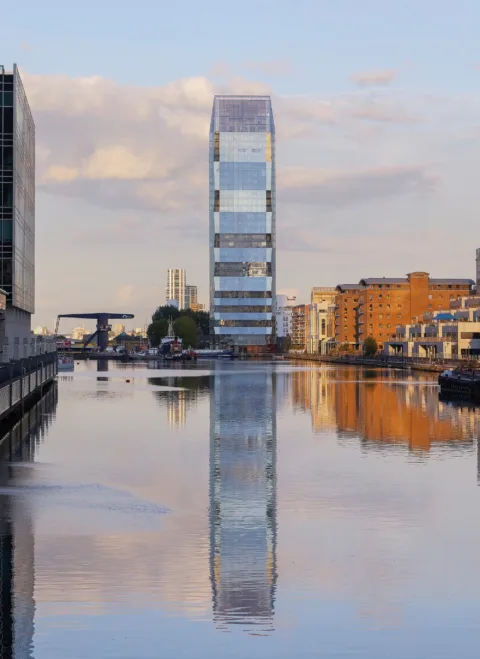
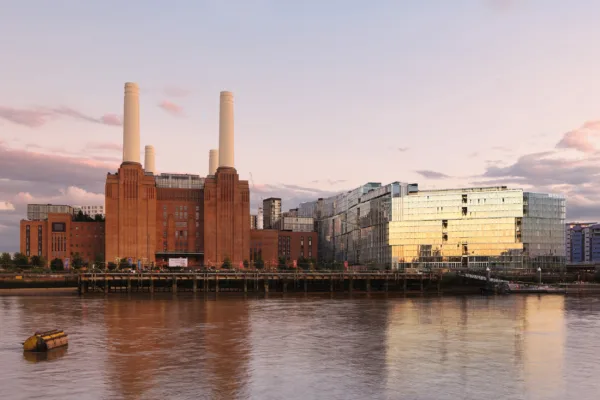
Just around the corner from the Solus showroom, is SimpsonHaugh’s London studio which they opened in the early 1990s. It is from this base that Ian and Rachel have overseen the design and delivery of iconic developments that have made a significant contribution to the London skyline such as One Blackfriars, Battersea Power Station Phase 1: Circus West Village, and Dollar Bay.
Ian and Rachel have been creating responsible, uplifting, and progressive architecture since their partnership began in Manchester in 1987. Their role in the masterplan for the rebuilding of the city centre helped kickstart the renaissance of the unofficial northern capital. SimpsonHaugh have earned a reputation for robust architecture that responds to local scale and context. Over the course of a couple of hours, we talked about their beginnings, their architectural approach, and their internationally successful practice.
Early influences and the path to architecture
Ian's initial encounters with architecture were unconventional. Growing up in a working-class background in North Manchester, his family's involvement in the demolition business exposed him to the destruction of old mills and warehouses. “It was my first real exposure to architecture, albeit in reverse,” he reflected. This experience instilled in him a profound appreciation for the materiality and structure of buildings.
Rachel's early influences were quite different, shaped by international design magazines and original artwork which her father brought home after international business trips as part of his work in the textile industry. Her mother also influenced her. “As part of her teacher training, my mother took a unit in architecture. I was captivated by the books, and this sparked my interest in the possibilities of design and the transformative power of the built environment.” she explained.
Despite facing discouragement from their school advisors, both Ian and Rachel were determined to pursue architecture. “We were drawn to architecture's ability to shape the world around us, to create spaces that inspire and uplift communities.”
Ian’s talents were nurtured by a visionary professor at Liverpool Polytechnic and after leaving, he joined Foster + Partners in London. Here he was able to see his designs become reality which struck him with a powerful sense of responsibility. He was named in a ‘40 under 40’ list and returned to Manchester, “I felt the city was on a scale where I could make a difference.”
Ian and Rachel first met while working together on a project at a practice in the northwest of England. They shared similar ambitions and started working together on competitions in their spare time. It was during this period that Ian began teaching at the School of Architecture at the University of Manchester, providing a source of income that would later allow them to set up practice together. Ian was awarded tenure at the university, but he and Rachel were already driven and determined to follow their aspirations in establishing their own practice. “We wanted to be more in control of what we represented architecturally.” Rachel explained.
From the city: transforming Manchester
It is no exaggeration to say that Ian and Rachel have contributed to the resurgence of Manchester through their architectural vision. Ian and Rachel established their practice here and built a strong reputation. Like many post-industrial cities in the last century, Manchester experienced a decline in manufacturing. SimpsonHaugh have played a significant role in helping to reimagine and rebuild the city in such a way that Manchester now enjoys international inward investment on a large scale.
Their early projects in the city played a crucial role in shaping their practice and commitment to urban transformation. One project saw them working with a group who were buying a semiderelict building in Knott Mill to refurbish. They were invited to join as partners and invest. Committing themselves financially meant they began to understand how to use money efficiently and where to place value.
“That building was a microcosm of our approach to the city. By allowing that building to have new life we could communicate more clearly what we were about.” explained Rachel. They gained the interest of the Central Manchester Development Corporation, who could see they were committed to what they termed “environmental improvement”. This culminated in grant funding being awarded for the regeneration of the area, with which they were able to help local owners and stakeholders upgrade their sites and buildings.
On the 15th of June 1996, in the heart of Manchester, the Provisional IRA exploded the largest bomb seen on the UK mainland since the Second World War. In current terms, the damage amounted to 1.4 billion pounds. Ian reflected, “The bombing was devastating but it was a catalyst for the reinvention of the city.”
SimpsonHaugh played a vital role in working with Manchester City Council to rehabilitate the fractured city centre. They focused on reconnecting the north and south of the city centre, creating pedestrian-friendly spaces and reintroducing residential life, creating the dense, walkable city centre that exists today. “Prior to the bomb, there were about 400 people living in the city centre. It was a 9-5 city of shops, offices, and brownfield sites.” Rachel observed.
Ian and Rachel are passionate urbanists who believe in density as an important part of the solution to social and environmental issues. “A city should have people living in it, but this is not always the case. Centres are often surrendered to commercial and retail development only.” Ian told me. SimpsonHaugh fought for the inclusion of residential space in the masterplan against the prevailing consensus and were proven right when the landmark development they had designed, No.1 Deansgate, became a huge success.
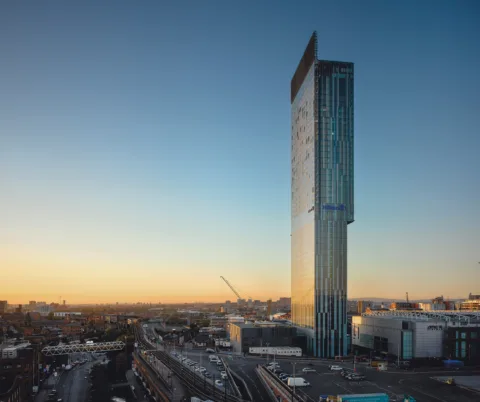
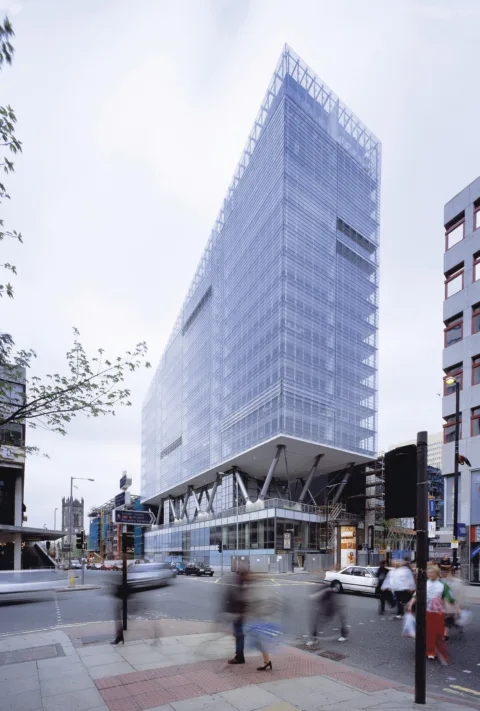
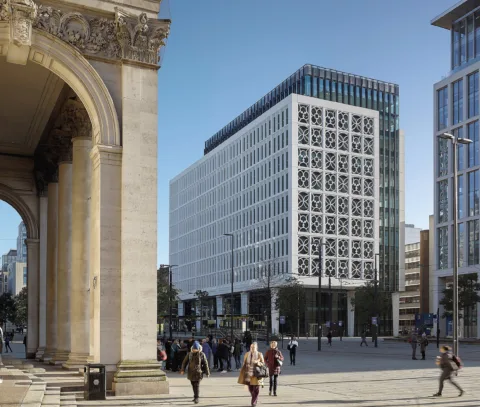
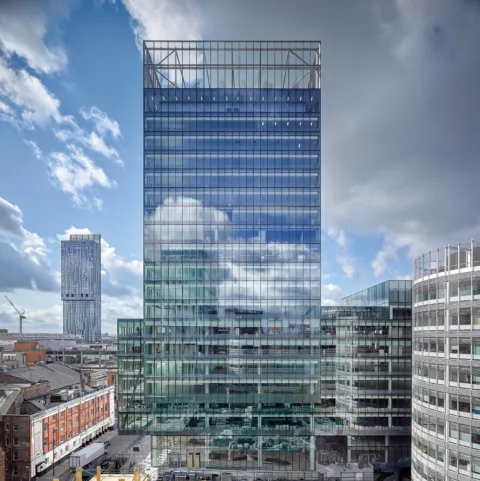
A tall building in Manchester was a bold and visionary move at the time but more were to follow. Cultural spaces like Urbis, now home of the National Football Museum, and the Beetham Tower, redefined the city vertically. Commercial spaces such as Two St Peter’s Square and No.1 Spinningfields used single sites to optimise the core. Reconstruction allowed the creation of connective space between the north and south of the city. Divided by the Irwell, Salford and Manchester were brought closer by the focussed development of New Cathedral Street, St Mary’s Gate, and Deansgate.
“The radius of the inner ring road of Manchester can be walked in 15 - 20 minutes,” Rachel explained, “the population of the city centre is now around 68,000 and we believe it should increase to at least 150,000. Density gives the city the critical mass that generates creativity and job creation. We need more people, jobs, schools, doctor’s surgeries, green spaces and amenities – all the things that attract and service a growing community.”
Manchester has benefitted from many years of political continuity, permitting its Labour-led council to develop fruitful relationships between the public and private sectors. The universities of Manchester have worked with the council to create a knowledge capital, something which external investors find attractive. By creating urban density in which creative encounters are more commonplace, SimpsonHaugh are fostering the same sort of collegiate atmosphere we find in Clerkenwell. Ian told me, “We can’t go out and get the investment, but we can support the pitch. The skyline can help sell the Manchester brand.”
Their influence on the life and identity of the city is not limited to skyline-changing buildings. A few steps away from their Knott Mill Studio, in the railway arches shouldering Deansgate station, was Atlas Autos. With friends, Ian and Rachel rented the premises in the late 80s / early 90s and opened one of Manchester’s first café bars, Atlas Bar. As a place to meet on the way in and out of town, it soon became a favourite with Manchester scenesters and an informal cultural hub. And while I can’t promise that you will bump into John Squire or DJ Paulette there these days, Atlas still stands – try the gin.
The partnership
Ian and Rachel’s collaborative approach to design is a defining characteristic of their practice. Their individual strengths complement each other, creating a dynamic that fuels their success. Ian possesses an immediate, intuitive response to a brief. “If I don’t have an idea within 12 seconds, I’m struggling,” he admitted. This rapid ideation allows them to quickly identify a powerful design direction. Rachel brings a measured and rigorous approach. “Ian tends to lead and present various approaches, and I respond,” she explained. Her detailed focus ensures that the initial vision is carried through to the final execution.
This complementary dynamic is exemplified in One Blackfriars, a complex project that spanned at least 15 years. Their collaborative approach ensured a consistent design vision throughout, with the final building embodying their original intent. “Being able to retain a vision through the detail is critical to delivering ambitious projects.” Rachel told me.
Their commitment extends throughout. “We feel passionately about taking a project through all the contractual stages and working collaboratively with the contractor to successfully deliver the projects that we are designing,” they emphasised. “We are committed to delivering our design proposals; the form, the shape, the materiality, all the way through from the external public spaces to the touch and detail of the internal environment.”
For Simpson and Haugh, the perceived conflict between commercial and design interests is a misapprehension. “Architecture is the reconciliation of commercial and design interests,” Ian stated. They view themselves as providers of a service, working closely with clients to achieve both aesthetic and functional goals. “We've never aspired to be artists in a garret. We want to build the things we design, not have our designs shelved and forgotten about.” Ian declared.
“All buildings have to be viable, have to work to a cost and a set of parameters,” they acknowledged. Over the years they have reconciled competing demands through what might be called “architecture by stealth”, a term that describes how they have understood the clients’ and stakeholders’ pragmatic requirements whilst trying to deliver the best architectural and civic solution, thereby allowing everyone to take ownership. The journey is just as important to them as the design and the efficacy of their approach is proven by their many repeat clients.
Innovative architecture has the power to shape and transform cities and the destinies of those within them. Ian and Rachel both have a strong sense of the responsibility of the architect to the wider community. “A key parameter for us is our responsibility to society to create buildings which are beautiful and appropriate to their context. It’s a civic responsibility. A building is for the long term.” Rachel explains.
To the world: expanding horizons
SimpsonHaugh's influence is increasingly recognised on the international stage. “We're proud of our Manchester roots and the global presence we have achieved over time through hard work and tenacity” Rachel stated, highlighting their reach beyond the UK.
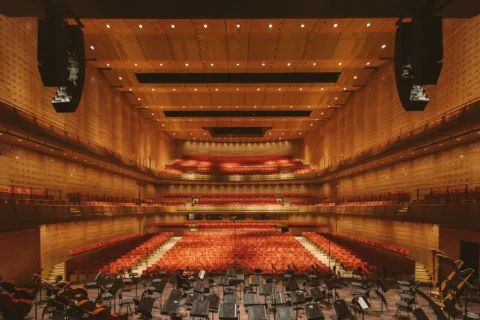
The recently completed Queen Elisabeth Hall, home of the Antwerp Symphony Orchestra, was an opportunity to demonstrate their contextual sensitivity. This rebuilding of a 1950s concert hall, embedded within a complex of important historic buildings, presented the opportunity to not only design an exemplary new symphonic concert hall but also to create a new public place for Antwerp.
Whilst bound by non-disclosure agreements, Ian revealed their current involvement in projects across the Middle East. “We're also exploring opportunities across the Asia Pacific region and North America,” he added, emphasising their commitment to global expansion.
Their urban design principles, tested and refined in Manchester, are adaptable to diverse international contexts. “In Manchester, we've tried to achieve a compact, walkable, city approach, and this ambition translates internationally,” Ian explained.
Reflecting on a recent conference in Chicago, Rachel drew parallels between Manchester and other post-industrial cities in the US which are undergoing similar transformations. “Industry has declined, and the question becomes what to do with the brownfield sites,” she observed. The importance of long-term governance and political stability in fostering strategic visions for the evolution of a city are key considerations for SimpsonHaugh.
When these conditions are in place, their ability to take the long view, to commit to a place, a client, and a community, is what differentiates SimpsonHaugh. Their deep engagement with a place, in its historical and future context, its materiality and its people, engenders an architecture that helps shape the future.
“We care passionately about adding value to the communities in which we operate, and we believe architects have a responsibility in shaping the built environment for future generations.” Ian said. “Good design transcends borders. It's about understanding the unique challenges and opportunities of each context and creating solutions that are both innovative and sensitive to the local environment.” Rachel added.
At SimpsonHaugh, 'evolving architecture' is a core philosophy. Every project is driven by the shared aspirations of the client, all stakeholders, and the design team. Simpson and Haugh are deeply invested in the wellbeing of the communities they design for, striving to create buildings and spaces that are not only aesthetically pleasing but also functional, inspiring, and appropriate for their context.
This commitment extends beyond the drawing board. Both Ian and Rachel have demonstrated their dedication by personally investing in their projects. Ian owns a penthouse at the top of the Beetham Tower, while Rachel calls No.1 Deansgate home. This approach underscores their belief in the transformative power of architecture and their commitment to creating places and spaces where people thrive.
NEWSLETTER
Get the latest news and updates sent straight to your inbox.

Under the Table with Simon Allford
29th May 2025

Dame Kelly Holmes: Unapologetically Driven
29th May 2025

In conversation with Juhani Pallasmaa
2nd Nov 2023


Meet the team: Domhnall McLaughlin
10th Jun 2026


Meet the team: Jade Whiteside
24th Apr 2026

Hearing the Eyes of the Skin
23rd Mar 2026

Under the Table with Glenn Howells
16th Jan 2026

Solus celebrates 30 years
11th Dec 2025


Meet the team: Luke Bajic, Specialist Product Consultant
29th Sept 2025


Under the Table with Simon Allford
29th May 2025


Meet the team: Aaron Taylor, London Area Sales Manager
30th Jan 2025

Meet the team: Lauren Riley, London Area Sales Manager
29th Jan 2025

Goodbye to 2024
17th Dec 2024


The story of the Ceramophone
23rd Feb 2024

Building Minds: In conversation with Frank Bruno
17th Jan 2024


In conversation with Juhani Pallasmaa
2nd Nov 2023


Solus Clerkenwell reopens its doors
31st Jul 2023

In conversation with Roger Tyrrell
21st Jun 2023

How can design drive optimism and change?
15th Jun 2023


In conversation with Mauro Mazzi, CEO of Mirage
17th Apr 2023


How do materials shape positive experiences?
6th Oct 2022

How can the design industry lead with purpose?
13th Jul 2022

Solus sponsors Birmingham charity walkathon
7th Jul 2022

Meet Ken Graham, Sustainability Manager
23rd May 2022

Solus celebrates 25 years
16th Mar 2020